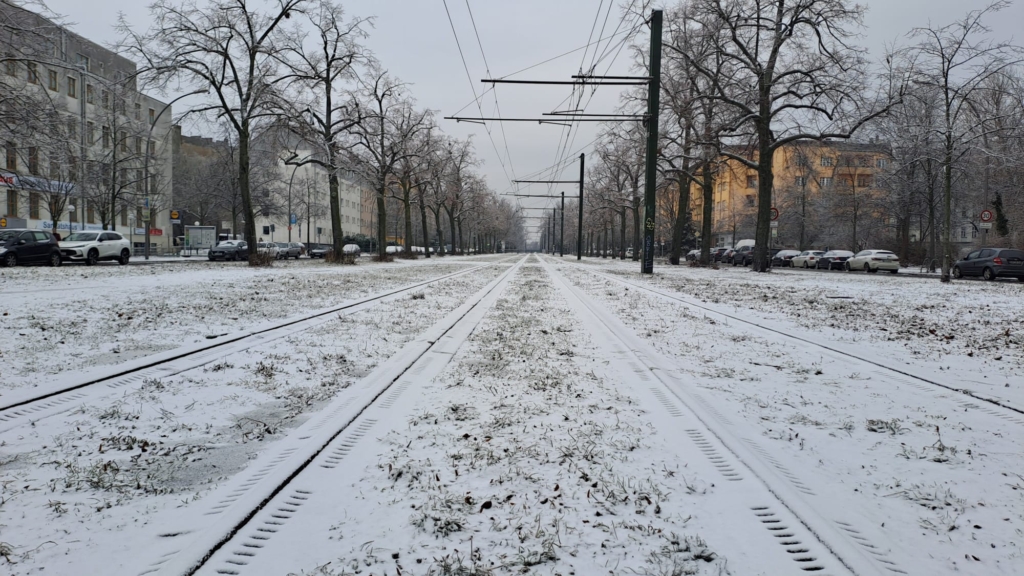
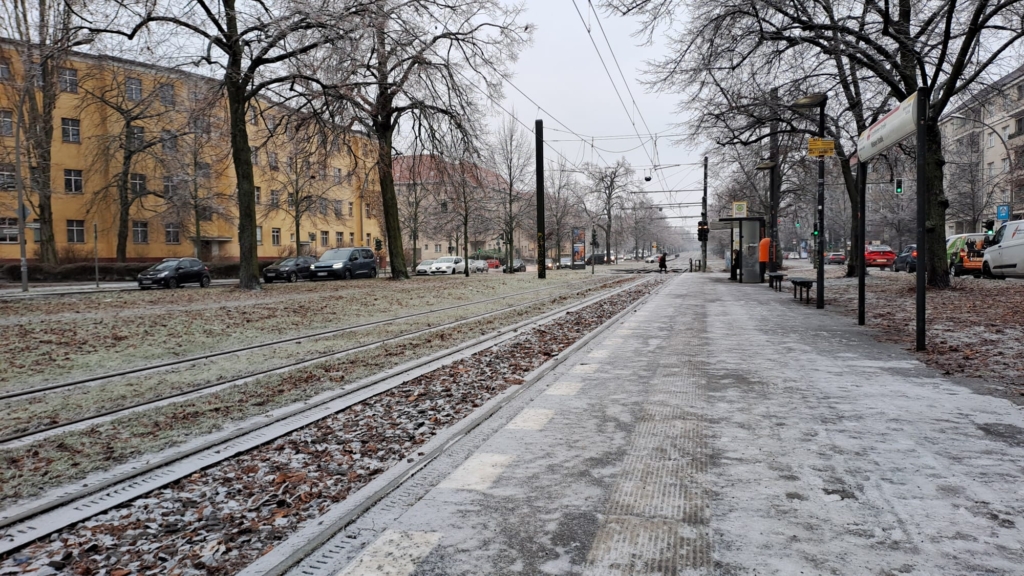
Almanya’daki tramvay sistemi geçen hafta hava koşullarından ötürü 2 gün çökmüş. Bizim tramvaylarımız kar kış demeden ilerliyorlar da tabii Berlin karasal iklim, bizimkiler böyle bir şeye dayanabilirler miydi acaba
Siteye gitmek istemeyenler için:
Standstill: The Berlin tram breakdown after freezing rain and its systemic causes
by
Michael Levy
Empty tram stop in Berlin's tram network: freezing rain and icy overhead lines forced the BVG to completely suspend tram services at the end of January 2026 I © UTM
The almost complete shutdown of Berlin’s tram service on 26 and 27 January 2026 marks one of the most serious weather-related disruptions to public transport in the capital in decades. What is remarkable here is not so much the intensity of the winter as its meteorological characteristics: it was not deep frost, but persistent temperatures around freezing point combined with freezing rain that brought the world’s third-largest tram network to a virtual standstill.
Just a few days earlier, Berlin had experienced temperatures as low as –15 °C, without significant operational restrictions on the tram network. The contrast could hardly be more striking. While dry frost is relatively manageable for electric rail systems, the unusual weather situation with freezing rain proved highly problematic for operations.
No traffic – For a day and a half, there were no trams running in Berlin I © UTM
The reason lies in the physics of the overhead lines: at temperatures around 0 °C, a thin but highly adhesive layer of ice forms on the contact wire, interrupting the electrical connection between the pantograph and the catenary. Under these conditions, new ice continuously accumulates, quickly negating any localized de-icing efforts.
The consequence: on the morning of Tuesday, 27 January, tram services were still impossible due to weather conditions. The BVG communicated this early to provide passengers with planning certainty – an important, if somewhat delayed, step.
The structural vulnerability of the system became particularly evident during de-icing. The overhead lines cannot be de-iced automatically. Instead, each section must be treated manually. Three tower vehicles were deployed, each staffed by three-person teams, removing the ice in physically demanding work.
In the first half of January, tram services continued to run smoothly despite sub-zero temperatures and snow I © UTM
This is compounded by a safety-critical procedure: after each tower vehicle passes, an empty tram must follow to check that power collection and vehicle systems function reliably. Only then can the section be reopened for regular passenger service.
In a network spanning roughly 200 km – normally a significant asset for urban mobility – this approach becomes a massive disadvantage in a crisis. Section by section, metre by metre, the effort is enormous, and the restoration of service necessarily slow.
The BVG repeatedly emphasized that staff safety is the highest priority. Working on tower vehicles in wet, icy, and slippery conditions requires full concentration and cannot be accelerated arbitrarily. While this is professionally understandable, it also highlights a structural problem: a system that relies entirely on hazardous, labour-intensive manual work in a crisis has insufficient technical resilience.
Manual labour – three tower wagons were used to de-ice the overhead line I © BVG / Florian Bündig
While the tram network was completely down, buses and the U-Bahn largely kept BVG operations running. Bus services remained mostly stable over the two days, though isolated delays occurred due to icy conditions.
Some U-Bahn sections were temporarily affected, notably on the U2, where rails had iced over. Positively, services returned relatively quickly: by 27 January, the U-Bahn was operating across the entire network, supported by a rail de-icing train. The U3 line was also fully back in service.
From Tuesday afternoon, tram services gradually resumed. Almost all Metro-Tram lines were operating again along their main axes, though with reduced frequencies. Supplementary bus replacement services were implemented on several routes.
Notably, despite continuous overnight runs to prevent further icing, a renewed spell of freezing rain on Monday night was sufficient to bring operations to a complete halt around 3:30 a.m., underlining the high vulnerability of the system to this specific weather scenario.
In addition to the clearly weather-related causes, there are also indications in the public debate that the extent of the operational disruptions may not be solely attributable to meteorological factors. In a report in the Berliner Zeitung, an anonymously quoted BVG employee expresses the view that internal organisational changes in recent years may have made it more difficult to deal with exceptional situations. Among other things, the informant mentions possible ambiguities in responsibilities and, in his view, insufficient systematic integration of operational experience into acute decision-making processes. These statements cannot be verified from the outside, but they do suggest that while the weather conditions were the immediate trigger, structural and organisational conditions may have at least influenced the course and duration of the disruptions. Further internal analyses would be necessary for a final assessment.
Vienna’s public transport system is also affected by freezing rain, but has clearly defined winter operating protocols that place greater emphasis on preventive measures. These include night-time de-icing runs, prioritised main routes and close coordination between the weather service, control centre and infrastructure management. Restrictions may also occur in Vienna, but a complete network failure is extremely rare.
Well equipped: snow plough tram in Vienna I © Wikipedia
Erfurter Verkehrsbetriebe (EVAG) is pursuing a different, much more proactive approach with its specially equipped overhead line de-icing vehicle. Based on a tram vehicle, this work vehicle is designed to de-ice frozen contact wires while moving and across the entire network – without having to rely on time-consuming manual work with tower wagons. The de-icing vehicle combines mechanical removal of ice from the contact wire with targeted heating, enabling a much faster restoration of power supply, especially in critical weather conditions around freezing point. The great advantage of this concept lies in its scalability: while in Berlin, each section has to be cleared manually, the EVAG de-icing vehicle can systematically treat larger parts of the network during night-time preventive runs, thus either preventing icing altogether or at least reducing it significantly. The example of Erfurt shows that even in medium-sized networks, significantly higher winter resilience can be achieved with manageable investments – an approach that would be particularly relevant for Berlin given the size of its network and the importance of its tram system.
A video about the EVAG de-icing vehicle can be found here:
Excerpt from the explanatory video about the Erfurt de-icing vehicle I © EVAG
The tram disruption in Berlin in January 2026 illustrates that the challenge lay less in the extremity of winter conditions than in the lack of structural preparation for a specific, yet foreseeable, weather scenario. Freezing rain at temperatures around the freezing point proved significantly more critical than deep frost, which the network appears to be better equipped to handle. The complete suspension of tram services highlighted that the system currently lacks graded operational modes that would allow at least a reduced, prioritized service along main axes. Instead, operators were faced with a binary choice between a total shutdown and a labor-intensive restoration of service.
At the same time, the incident exposed a technical reliance on manual de-icing, which is barely scalable given a network of approximately 200 km. Exclusive use of tower vehicles and handwork is not only time-consuming but also requires substantial personnel resources and increases the risks for staff. Comparisons with other transport operators indicate that vehicle-based or semi-automated de-icing solutions—such as dedicated overhead-line de-icing vehicles or preventive de-icing runs—can significantly reduce vulnerability to freezing rain without compromising safety standards.
Furthermore, the Berlin case underscores that winter resilience is not merely a matter of technology but also of operational management. Early meteorological warnings must be systematically translated into operational decisions, for example through preventive night-time runs, reinforcement of staffing during critical periods, and pre-planned contingency measures. While buses and the U-Bahn effectively fulfilled their role as stabilizing elements of the overall system, the tram network lacked a comparable level of operational flexibility.
The M13 tram line slowly resumed service on the afternoon of 27 January I © UTM
The central lesson, therefore, is that a growing tram network must not only be planned with demand and climate policy in mind but also designed and operated to withstand adverse weather conditions. As network density increases, so too does the operational importance of the system and the responsibility to maintain at least partial service under challenging conditions. The Berlin tram standstill in January 2026 should thus be seen not as an isolated anomaly but as a strategic wake-up call to rethink winter operations, infrastructure, and crisis management in a more integrated and resilient manner.
The shutdown of Berlin’s tram system in January 2026 was less an operational accident than a symptom of structural underinvestment in winter resilience. While the underground and buses fulfilled their role as the backbone of the system, the tram revealed a critical imbalance between network size and technical robustness.
In a European comparison, Vienna and Zurich show that even under difficult meteorological conditions, operational reliability is not a matter of chance, but the result of long-term prioritisation. For Berlin, the question is not so much whether such weather conditions will occur again, but whether the system will be better prepared next time.
27.01.2026


 rayhaber.com