Tema düzenleyici

Toplu Taşıma / Kentsel Planlama / Şehircilik ile Alakalı Makale, Haber vb. Paylaşımı

merhabalar. bunu serbest kürsüye açmak doğru gelmedi onun için @kısayolunuzunu 'n verdiği cesaretle buraya açıyorum. buraya yukarıdaki konular veya ona bağlantılı herhangi bir konuyla alakalı gördüğünüz yazıları paylaşabilirsiniz. Dil sınırlaması yoktur. ilk olarak ben başlatayım:

Dünyadan ziyade Amerika'yla alakalı bir yazı gördüm. Fakat yorumlarda Chris adlı arkadaşın bence sınırları aşan şu yazdıklarına dikkatinizi celbetmek isterim. Özellikle siyahla işaretlediğim yeri önemli buldum:

“Public transit’s costs and benefits are both primarily local (as opposed to something like intercity rail or airports, which exist interaction with faraway places beyond the normal workday commute/labor shed), so services should reflect local needs. Most of the costs of transit are operations: the stuff you cannot avoid and must pay in order to keep what you have (labor, maintenance, fuel, dispatching, service yards, call centers, communications). This is the big hurdle, because transit cannot make money because in order for it to be useful, a lot of unproductive service must be run (peak > weekday midday > weekend daylight > weeknight > weekend night > overnight) as well as coverage services that support ridership services.
Getting a stable subsidy source is important to make a service useful, which means different things to different people. For people who don’t work 9-to-5, it means having bus service available predawn or past sundown. For people living on other people’s schedules (work, school, appointments), it means service frequent enough to show up and go and arrive at both ends in a reasonable amount of time. A frequency of 15 minutes is the point where people will make spontaneous trips and command the schedule to memory, and generally results in the least time wasted in terms of endpoint connections, and still reasonable to make with timed transfers.”

DeepL’den çeviri:
Toplu taşıma maliyetleri ve faydaları öncelikle yerel niteliktedir (normal iş günü işe gidip gelme/iş gücü havzası dışındaki uzak yerlerle etkileşim içinde olan şehirlerarası demiryolları veya havaalanları gibi ulaşım araçlarının aksine), bu nedenle hizmetler yerel ihtiyaçları yansıtmalıdır. Toplu taşıma maliyetlerinin çoğu işletme maliyetleridir: sahip olduklarınızı korumak için kaçınamayacağınız ve ödemek zorunda olduğunuz şeyler (işçilik, bakım, yakıt, sevkiyat, servis sahaları, çağrı merkezleri, iletişim). Bu büyük bir engeldir, çünkü toplu taşıma, yararlı olabilmesi için birçok verimsiz hizmetin (yoğun saatler > hafta içi öğlen > hafta sonu gündüz > hafta içi gece > hafta sonu gece > gece) yanı sıra yolcu hizmetlerini destekleyen kapsama hizmetlerinin de yürütülmesi gerektiğinden para kazanamaz.”

“Hizmetin kullanışlı olması için istikrarlı bir sübvansiyon kaynağına sahip olmak önemlidir, ancak bu farklı kişiler için farklı anlamlar ifade eder. 9-5 mesaisi olmayan kişiler için bu, şafak sökmeden önce veya gün batımından sonra otobüs hizmetinin mevcut olması anlamına gelir. Başkalarının programlarına (iş, okul, randevular) göre yaşayan insanlar için ise, makul bir sürede varış noktasına ulaşmak için yeterince sık hizmet sunulması anlamına gelir. 15 dakikalık sıklık, insanların spontane seyahatler yapıp programı ezberleyecekleri noktadır ve genellikle varış noktası bağlantıları açısından en az zaman kaybına neden olur ve zamanlı aktarmalarla hala makul bir seçenektir.”

kaynak: Many Americans Are Open to Car-Free Living — Human Transit yorumları
 
Son düzenleme:
Konu sahibi
Son düzenleme:
Konu sahibi

Attığım sayfadaki ilk örnekten başlıyorum. Kısa bir tanımı ve örnek olarak nereye uygun olacağı verilmiş.​

Absorbent Daylighting​

Nov 20, 2024
GIF show what absorbent daylighting looks like.

Clearing the curb space next to a crosswalk and upgrading that space with bioswales, green gutters, and other surfaces that allow water to seep into the earth benefits flood-prone neighborhoods with excess asphalt and limited permeable surface area. Installing just one bioswale can manage between 1,100 and 2,200 gallons of water during a storm — reducing the risk of flash floods, maintaining accessibility for people on foot, and keeping water out of basement apartment units.

Case Study: Brighton Beach, Brooklyn​

Brighton Beach has no absorbent green infrastructure and less permeable surface area than almost any neighborhood in New York City. With flooding common at high tides and during extreme rainfall, Brighton Beach residents would dramatically benefit from installing absorbent daylighting at every intersection.
graphic showing absorbent daylighting.


Bizde bence Doğu Karadeniz’e uygun.
Sürekli sel oluyor, yağış bol olduğu için bakımı da fazla zorlamaz
 
Konu sahibi

Neden Berlin’de tramvay sisteminin 2 günlüğüne (26-27 Ocak) çöktüğünün sebeplerini açıklayan bir haber.​

Standstill: The Berlin tram breakdown after freezing rain and its systemic causes​

by Michael Levy
Berlin-Tram-Eis-3-1-656x337.jpg

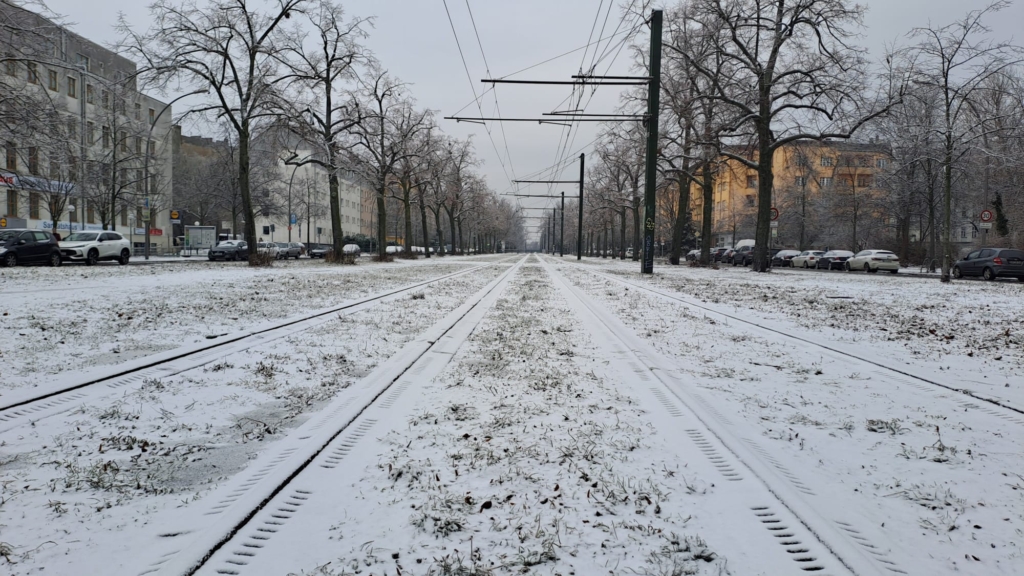
Empty tram stop in Berlin's tram network: freezing rain and icy overhead lines forced the BVG to completely suspend tram services at the end of January 2026 I © UTM
The almost complete shutdown of Berlin’s tram service on 26 and 27 January 2026 marks one of the most serious weather-related disruptions to public transport in the capital in decades. What is remarkable here is not so much the intensity of the winter as its meteorological characteristics: it was not deep frost, but persistent temperatures around freezing point combined with freezing rain that brought the world’s third-largest tram network to a virtual standstill.

Freezing rain instead of extreme frost – a critical difference​

Just a few days earlier, Berlin had experienced temperatures as low as –15 °C, without significant operational restrictions on the tram network. The contrast could hardly be more striking. While dry frost is relatively manageable for electric rail systems, the unusual weather situation with freezing rain proved highly problematic for operations.

Berlin-Tram-Eis-2-1024x576.jpg
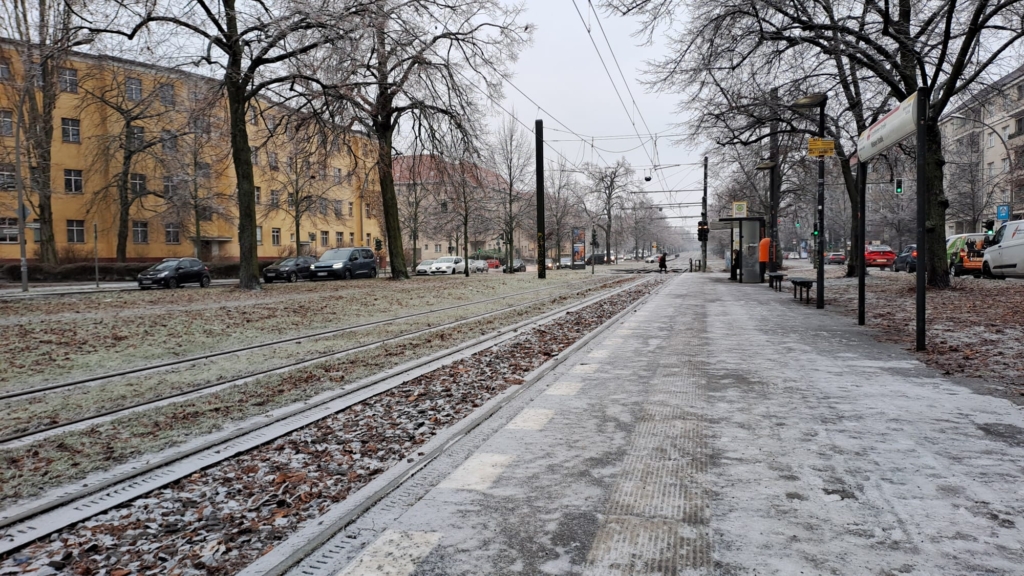
No traffic – For a day and a half, there were no trams running in Berlin I © UTM
The reason lies in the physics of the overhead lines: at temperatures around 0 °C, a thin but highly adhesive layer of ice forms on the contact wire, interrupting the electrical connection between the pantograph and the catenary. Under these conditions, new ice continuously accumulates, quickly negating any localized de-icing efforts.

The consequence: on the morning of Tuesday, 27 January, tram services were still impossible due to weather conditions. The BVG communicated this early to provide passengers with planning certainty – an important, if somewhat delayed, step.

200 Kilometres of Network – All Manual Work

The structural vulnerability of the system became particularly evident during de-icing. The overhead lines cannot be de-iced automatically. Instead, each section must be treated manually. Three tower vehicles were deployed, each staffed by three-person teams, removing the ice in physically demanding work.

Berlin_OePNV_2026_01_07_031.jpg
In the first half of January, tram services continued to run smoothly despite sub-zero temperatures and snow I © UTM
This is compounded by a safety-critical procedure: after each tower vehicle passes, an empty tram must follow to check that power collection and vehicle systems function reliably. Only then can the section be reopened for regular passenger service.

In a network spanning roughly 200 km – normally a significant asset for urban mobility – this approach becomes a massive disadvantage in a crisis. Section by section, metre by metre, the effort is enormous, and the restoration of service necessarily slow.

Operational Priorities: Safety Over Speed

The BVG repeatedly emphasized that staff safety is the highest priority. Working on tower vehicles in wet, icy, and slippery conditions requires full concentration and cannot be accelerated arbitrarily. While this is professionally understandable, it also highlights a structural problem: a system that relies entirely on hazardous, labour-intensive manual work in a crisis has insufficient technical resilience.

Drei-Turmwagen-sind-zur-Enteisung-der-Oberleitungen-rund-um-die-Uhr-im-Einsatz_1_Foto-BVG-Florian-Buendig-1024x683.jpg
Manual labour – three tower wagons were used to de-ice the overhead line I © BVG / Florian Bündig

Stabilising Role of metro and bus services​

While the tram network was completely down, buses and the U-Bahn largely kept BVG operations running. Bus services remained mostly stable over the two days, though isolated delays occurred due to icy conditions.

Some U-Bahn sections were temporarily affected, notably on the U2, where rails had iced over. Positively, services returned relatively quickly: by 27 January, the U-Bahn was operating across the entire network, supported by a rail de-icing train. The U3 line was also fully back in service.

Gradual Tram Recovery – With Limitations​

From Tuesday afternoon, tram services gradually resumed. Almost all Metro-Tram lines were operating again along their main axes, though with reduced frequencies. Supplementary bus replacement services were implemented on several routes.

Notably, despite continuous overnight runs to prevent further icing, a renewed spell of freezing rain on Monday night was sufficient to bring operations to a complete halt around 3:30 a.m., underlining the high vulnerability of the system to this specific weather scenario.

References to organisational factors beyond the weather conditions​

In addition to the clearly weather-related causes, there are also indications in the public debate that the extent of the operational disruptions may not be solely attributable to meteorological factors. In a report in the Berliner Zeitung, an anonymously quoted BVG employee expresses the view that internal organisational changes in recent years may have made it more difficult to deal with exceptional situations. Among other things, the informant mentions possible ambiguities in responsibilities and, in his view, insufficient systematic integration of operational experience into acute decision-making processes. These statements cannot be verified from the outside, but they do suggest that while the weather conditions were the immediate trigger, structural and organisational conditions may have at least influenced the course and duration of the disruptions. Further internal analyses would be necessary for a final assessment.

Looking to Vienna and Erfurt​

Vienna’s public transport system is also affected by freezing rain, but has clearly defined winter operating protocols that place greater emphasis on preventive measures. These include night-time de-icing runs, prioritised main routes and close coordination between the weather service, control centre and infrastructure management. Restrictions may also occur in Vienna, but a complete network failure is extremely rare.

Wien-Wiener-Linien-Schneepflug.jpeg
Well equipped: snow plough tram in Vienna I © Wikipedia

Best practice from Erfurt: EVAG’s overhead line de-icing vehicle​

Erfurter Verkehrsbetriebe (EVAG) is pursuing a different, much more proactive approach with its specially equipped overhead line de-icing vehicle. Based on a tram vehicle, this work vehicle is designed to de-ice frozen contact wires while moving and across the entire network – without having to rely on time-consuming manual work with tower wagons. The de-icing vehicle combines mechanical removal of ice from the contact wire with targeted heating, enabling a much faster restoration of power supply, especially in critical weather conditions around freezing point. The great advantage of this concept lies in its scalability: while in Berlin, each section has to be cleared manually, the EVAG de-icing vehicle can systematically treat larger parts of the network during night-time preventive runs, thus either preventing icing altogether or at least reducing it significantly. The example of Erfurt shows that even in medium-sized networks, significantly higher winter resilience can be achieved with manageable investments – an approach that would be particularly relevant for Berlin given the size of its network and the importance of its tram system.

A video about the EVAG de-icing vehicle can be found here:


Erfurt-EVAG-Enteisung-1024x520.png
Excerpt from the explanatory video about the Erfurt de-icing vehicle I © EVAG

Lessons from the Berlin Tram Standstill​

The tram disruption in Berlin in January 2026 illustrates that the challenge lay less in the extremity of winter conditions than in the lack of structural preparation for a specific, yet foreseeable, weather scenario. Freezing rain at temperatures around the freezing point proved significantly more critical than deep frost, which the network appears to be better equipped to handle. The complete suspension of tram services highlighted that the system currently lacks graded operational modes that would allow at least a reduced, prioritized service along main axes. Instead, operators were faced with a binary choice between a total shutdown and a labor-intensive restoration of service.

At the same time, the incident exposed a technical reliance on manual de-icing, which is barely scalable given a network of approximately 200 km. Exclusive use of tower vehicles and handwork is not only time-consuming but also requires substantial personnel resources and increases the risks for staff. Comparisons with other transport operators indicate that vehicle-based or semi-automated de-icing solutions—such as dedicated overhead-line de-icing vehicles or preventive de-icing runs—can significantly reduce vulnerability to freezing rain without compromising safety standards.

Furthermore, the Berlin case underscores that winter resilience is not merely a matter of technology but also of operational management. Early meteorological warnings must be systematically translated into operational decisions, for example through preventive night-time runs, reinforcement of staffing during critical periods, and pre-planned contingency measures. While buses and the U-Bahn effectively fulfilled their role as stabilizing elements of the overall system, the tram network lacked a comparable level of operational flexibility.

Berlin-Tram-Eis-4-1024x576.jpg
The M13 tram line slowly resumed service on the afternoon of 27 January I © UTM
The central lesson, therefore, is that a growing tram network must not only be planned with demand and climate policy in mind but also designed and operated to withstand adverse weather conditions. As network density increases, so too does the operational importance of the system and the responsibility to maintain at least partial service under challenging conditions. The Berlin tram standstill in January 2026 should thus be seen not as an isolated anomaly but as a strategic wake-up call to rethink winter operations, infrastructure, and crisis management in a more integrated and resilient manner.

Conclusion​

The shutdown of Berlin’s tram system in January 2026 was less an operational accident than a symptom of structural underinvestment in winter resilience. While the underground and buses fulfilled their role as the backbone of the system, the tram revealed a critical imbalance between network size and technical robustness.

In a European comparison, Vienna and Zurich show that even under difficult meteorological conditions, operational reliability is not a matter of chance, but the result of long-term prioritisation. For Berlin, the question is not so much whether such weather conditions will occur again, but whether the system will be better prepared next time.

27.01.2026

Kaynak:Standstill: The Berlin tram breakdown after freezing rain and its systemic causes - Urban Transport Magazine
 
Konu sahibi
New York'la alakalı lakin bizim de uygulayabileceğimiz kısımlar olduğunu düşündüğüm bir yazı paylaşacağım. Kentsel tasarımın toplumsal altyapı olarak kullanılmasını savunuyor. kendim de altını çizdiğim yerler oldu:

Urban Design as Social Infrastructure​

JULIA D. DAY​

JANUARY 28, 2026​

Investments in the physical city are essential to achieving Zohran Mamdani’s goal of creating a fair and affordable New York.​


Zohran Mamdani’s campaign for mayor treated New York’s physical city not as backdrop, but as protagonist. Mamdani met (and, as mayor, has continued meeting) New Yorkers where daily life actually unfolds — on sidewalks, buses, subways, beaches and street corners — underscoring a simple truth: The physical city is where government shows up most tangibly in people’s lives.

Streets, parks, plazas, housing, transit, libraries, waterfronts and public buildings form the connective tissue of civic life. When these places are well designed, well maintained and well programmed, they function as social infrastructure, enabling relationships to form, civic trust to grow and communities to thrive. Investing in social infrastructure is therefore not just an urban design strategy — it is a way to make policy visible and effective on every block, every day.

Today, investment and upkeep in this essential social infrastructure are fragmented and often depend on private fundraising or volunteer labor, leaving too many neighborhoods behind. This patchwork model undermines fairness — and makes it difficult to deliver improvements at the scale New Yorkers need. To deliver on Mamdani’s promise of a fairer, more affordable city, the administration should create a social infrastructure plan to coordinate capital investment, maintenance and stewardship across agencies and communities

In his early days as mayor, Mamdani has given every indication that he understands the importance of investing in the physical city to make the city a more livable place where people can connect and thrive. The appointment of Mike Flynn, the co-author of New York’s first Street Design Manual, to run the Department of Transportation is one of multiple steps in the right direction. Now, strong appointments and symbolic gestures must be matched with good policy. Making a citywide social infrastructure plan an early governing priority will serve as a practical blueprint for guiding investments in the physical city and the people who steward it. In practice, it’s a framework to guide what gets created, where, and who maintains and programs these spaces over time.

Public space as essential social infrastructure​

Mamdani understands that public spaces are not simply nice-to-have amenities; they are platforms for building civic trust, creating resilient neighborhoods and connecting New Yorkers to social and economic opportunity. His recent commitment to complete the redesign on McGuinness Boulevard, a safe streets project stalled by the Adams administration, is evidence of this. Beyond safety, well-designed public spaces can lower the cost of living by providing free or low-cost places to gather, rest, play, learn, meet neighbors and access services.

Research consistently shows that access to quality public spaces strengthens social cohesion and trust in government.
A 2017 Center for Active Design report found that residents without access to quality parks report lower levels of connection and trust in government. The same can be said of libraries, rec centers and other well-designed buildings and civic spaces maintained with pride.

Features as simple as seating, greenery, shade and interactive programming can significantly increase social interaction and a sense of belonging, as Gehl (my urban design firm) found in “Rx for Social Connection” research with The Bentway and the Dalla Lana School of Public Health.

Public spaces also play a critical role in safety, broadly defined. Environmental design features in urban spaces, such as greening vacant lots or improving street lighting, has been associated with crime reduction. New York City’s Active Design Guidelines correctly suggest that public spaces are vital to supporting public health. And new research from the Shared Mobility Center connects social infrastructure to climate resilience.

All of these positive outcomes come from treating public space not as a nice amenity but as essential social infrastructure, something the government must intentionally design, fund and sustain.

From fragmentation to coordination​

New York has a long history of investing in the physical city, but these efforts have too often been fragmented, under-resourced and inequitable.

Park maintenance relies heavily on private fundraising. Without it, parks, especially in the outer boroughs, often don’t meet the Department of Parks and Recreation’s own standards for cleanliness, safety and accessibility. Many plazas and streetscapes depend on Business Improvement Districts for upkeep; open streets and school streets depend on volunteer labor, complex permitting and costly insurance.

This patchwork model undermines scale and fairness. It also contrasts with Mamdani’s commitment to relentless competence — a government that delivers faster, fairer and more visible results.

While the city urgently needs more affordable housing, housing alone does not create thriving neighborhoods. Mamdani seems to understand this; he has spoken of parks as among the few spaces that are “truly accessible and affordable to each and every person who calls the city home,” saying the goal of public spaces is to ensure that a “dignified life is available to each and every New Yorker.”

Residents badly need safe routes to schools, green space, convenient and dignified bus stops, libraries, plazas and non-commercial “third spaces” where people can simply be. Social infrastructure must be planned with housing, not added later if and when funding allows.

A social infrastructure plan would mark an important shift for New York, serving as a practical implementation guide for programs from school streets to bus stops and helping to operationalize a people-first approach to governance that requires multi-agency involvement.

Such a framework would move New York from patching together one-off wins to a reliable citywide system built on neighborhood planning models already put in place by the Department of City Planning. It would focus on five things:

  • assessing social and physical needs and assets in neighborhoods together
  • identifying priority neighborhoods where investment can deliver the greatest benefit
  • aligning public realm improvements with planned capital projects and service delivery
  • setting measurable outcomes related to affordability, safety, health and connection; and
  • establishing sustainable models for stewardship, programming and funding in partnership with community organizations and leaders

Because social infrastructure functions as a network, no single agency can deliver it alone. Effective implementation requires a networked governance model, with clear accountability for coordination across agencies such as the Departments of Transportation, Parks and Recreation, Design and Construction, Housing and Preservation, Sanitation and even the new Mayor’s Office of Mass Engagement. This could mean strengthening the role of Chief Public Realm Officer created by Mayor Adams, perhaps creating a deputy mayor of operations for the public realm, as a coalition of public realm advocates is calling for — or establishing a dedicated social infrastructure officer with a mandate to oversee the system, identify priorities and drive implementation.

New York already has strong local precedents for how city agencies and community partners can work together to develop social infrastructure. At Paseo Park in Jackson Heights, what began as an Open Streets pilot during the pandemic has become a permanent, multi-block civic asset supporting thousands of public school students and local residents alike. The new street furniture designed to slow vehicular traffic at intersections was designed and installed in close collaboration with the local community.

The city’s pedestrian plaza program is another example. By providing a clear application process and design toolkit, neighborhood organizations can apply to create their own plazas. The Public Space Equity program is a tool to ensure neighborhoods with fewer financial resources can maintain these spaces as well.

Scaling these efforts requires reducing red tape, standardizing permitting and insurance pathways, and making it easier for local organizations to occupy and activate public space. A people-first city invests not only in physical improvements, but in the systems that allow communities to use and care for them over time.

Sweat the small stuff​

As he presses ahead, Mamdani should be mindful of the fact that investing in connection often means making straightforward, human-scale improvements: securing safe places for children to play, shaded seating at bus stops that double as platforms for community information, lighting that enhances safety without floodlighting neighborhoods and greenery that supports both mental health and climate resilience. On a recent Brian Lehrer episode about “sewer socialism,” the New Yorkers who called in made clear they were not asking for the moon — just basic quality urban design and upkeep: evenly paved sidewalks, painted crosswalks, street trees.

This is not an argument against major citywide infrastructure projects. New York needs those too, from new pedestrian and bike bridges, as Sam Schwartz has recommended, to the redesign of Penn Station. Jens Kramer, the former four-term mayor of Copenhagen who was largely responsible for its transformation into one of the most livable cities in the world, has said that mayors have to identify how investments in citywide spaces are balanced with those in neighborhoods. The challenge is ensuring that flagship investments are matched by neighborhood-scale improvements that people experience every day.

By heeding this wisdom, and by treating social infrastructure as essential civic infrastructure, Mayor Mamdani can position New York as a global leader in people-centered urban policy — strengthening the physical city as the backbone of health, connection and democracy itself.

Kaynak:Vital City | Urban Design as Social Infrastructure
 
Son düzenleme:

Neden Berlin’de tramvay sisteminin 2 günlüğüne (26-27 Ocak) çöktüğünün sebeplerini açıklayan bir haber.​

Standstill: The Berlin tram breakdown after freezing rain and its systemic causes​

by Michael Levy
Berlin-Tram-Eis-3-1-656x337.jpg

Empty tram stop in Berlin's tram network: freezing rain and icy overhead lines forced the BVG to completely suspend tram services at the end of January 2026 I © UTM
The almost complete shutdown of Berlin’s tram service on 26 and 27 January 2026 marks one of the most serious weather-related disruptions to public transport in the capital in decades. What is remarkable here is not so much the intensity of the winter as its meteorological characteristics: it was not deep frost, but persistent temperatures around freezing point combined with freezing rain that brought the world’s third-largest tram network to a virtual standstill.

Freezing rain instead of extreme frost – a critical difference​

Just a few days earlier, Berlin had experienced temperatures as low as –15 °C, without significant operational restrictions on the tram network. The contrast could hardly be more striking. While dry frost is relatively manageable for electric rail systems, the unusual weather situation with freezing rain proved highly problematic for operations.

Berlin-Tram-Eis-2-1024x576.jpg
No traffic – For a day and a half, there were no trams running in Berlin I © UTM
The reason lies in the physics of the overhead lines: at temperatures around 0 °C, a thin but highly adhesive layer of ice forms on the contact wire, interrupting the electrical connection between the pantograph and the catenary. Under these conditions, new ice continuously accumulates, quickly negating any localized de-icing efforts.

The consequence: on the morning of Tuesday, 27 January, tram services were still impossible due to weather conditions. The BVG communicated this early to provide passengers with planning certainty – an important, if somewhat delayed, step.

200 Kilometres of Network – All Manual Work

The structural vulnerability of the system became particularly evident during de-icing. The overhead lines cannot be de-iced automatically. Instead, each section must be treated manually. Three tower vehicles were deployed, each staffed by three-person teams, removing the ice in physically demanding work.

Berlin_OePNV_2026_01_07_031.jpg
In the first half of January, tram services continued to run smoothly despite sub-zero temperatures and snow I © UTM
This is compounded by a safety-critical procedure: after each tower vehicle passes, an empty tram must follow to check that power collection and vehicle systems function reliably. Only then can the section be reopened for regular passenger service.

In a network spanning roughly 200 km – normally a significant asset for urban mobility – this approach becomes a massive disadvantage in a crisis. Section by section, metre by metre, the effort is enormous, and the restoration of service necessarily slow.

Operational Priorities: Safety Over Speed

The BVG repeatedly emphasized that staff safety is the highest priority. Working on tower vehicles in wet, icy, and slippery conditions requires full concentration and cannot be accelerated arbitrarily. While this is professionally understandable, it also highlights a structural problem: a system that relies entirely on hazardous, labour-intensive manual work in a crisis has insufficient technical resilience.

Drei-Turmwagen-sind-zur-Enteisung-der-Oberleitungen-rund-um-die-Uhr-im-Einsatz_1_Foto-BVG-Florian-Buendig-1024x683.jpg
Manual labour – three tower wagons were used to de-ice the overhead line I © BVG / Florian Bündig

Stabilising Role of metro and bus services​

While the tram network was completely down, buses and the U-Bahn largely kept BVG operations running. Bus services remained mostly stable over the two days, though isolated delays occurred due to icy conditions.

Some U-Bahn sections were temporarily affected, notably on the U2, where rails had iced over. Positively, services returned relatively quickly: by 27 January, the U-Bahn was operating across the entire network, supported by a rail de-icing train. The U3 line was also fully back in service.

Gradual Tram Recovery – With Limitations​

From Tuesday afternoon, tram services gradually resumed. Almost all Metro-Tram lines were operating again along their main axes, though with reduced frequencies. Supplementary bus replacement services were implemented on several routes.

Notably, despite continuous overnight runs to prevent further icing, a renewed spell of freezing rain on Monday night was sufficient to bring operations to a complete halt around 3:30 a.m., underlining the high vulnerability of the system to this specific weather scenario.

References to organisational factors beyond the weather conditions​

In addition to the clearly weather-related causes, there are also indications in the public debate that the extent of the operational disruptions may not be solely attributable to meteorological factors. In a report in the Berliner Zeitung, an anonymously quoted BVG employee expresses the view that internal organisational changes in recent years may have made it more difficult to deal with exceptional situations. Among other things, the informant mentions possible ambiguities in responsibilities and, in his view, insufficient systematic integration of operational experience into acute decision-making processes. These statements cannot be verified from the outside, but they do suggest that while the weather conditions were the immediate trigger, structural and organisational conditions may have at least influenced the course and duration of the disruptions. Further internal analyses would be necessary for a final assessment.

Looking to Vienna and Erfurt​

Vienna’s public transport system is also affected by freezing rain, but has clearly defined winter operating protocols that place greater emphasis on preventive measures. These include night-time de-icing runs, prioritised main routes and close coordination between the weather service, control centre and infrastructure management. Restrictions may also occur in Vienna, but a complete network failure is extremely rare.

Wien-Wiener-Linien-Schneepflug.jpeg
Well equipped: snow plough tram in Vienna I © Wikipedia

Best practice from Erfurt: EVAG’s overhead line de-icing vehicle​

Erfurter Verkehrsbetriebe (EVAG) is pursuing a different, much more proactive approach with its specially equipped overhead line de-icing vehicle. Based on a tram vehicle, this work vehicle is designed to de-ice frozen contact wires while moving and across the entire network – without having to rely on time-consuming manual work with tower wagons. The de-icing vehicle combines mechanical removal of ice from the contact wire with targeted heating, enabling a much faster restoration of power supply, especially in critical weather conditions around freezing point. The great advantage of this concept lies in its scalability: while in Berlin, each section has to be cleared manually, the EVAG de-icing vehicle can systematically treat larger parts of the network during night-time preventive runs, thus either preventing icing altogether or at least reducing it significantly. The example of Erfurt shows that even in medium-sized networks, significantly higher winter resilience can be achieved with manageable investments – an approach that would be particularly relevant for Berlin given the size of its network and the importance of its tram system.

A video about the EVAG de-icing vehicle can be found here:


Erfurt-EVAG-Enteisung-1024x520.png
Excerpt from the explanatory video about the Erfurt de-icing vehicle I © EVAG

Lessons from the Berlin Tram Standstill​

The tram disruption in Berlin in January 2026 illustrates that the challenge lay less in the extremity of winter conditions than in the lack of structural preparation for a specific, yet foreseeable, weather scenario. Freezing rain at temperatures around the freezing point proved significantly more critical than deep frost, which the network appears to be better equipped to handle. The complete suspension of tram services highlighted that the system currently lacks graded operational modes that would allow at least a reduced, prioritized service along main axes. Instead, operators were faced with a binary choice between a total shutdown and a labor-intensive restoration of service.

At the same time, the incident exposed a technical reliance on manual de-icing, which is barely scalable given a network of approximately 200 km. Exclusive use of tower vehicles and handwork is not only time-consuming but also requires substantial personnel resources and increases the risks for staff. Comparisons with other transport operators indicate that vehicle-based or semi-automated de-icing solutions—such as dedicated overhead-line de-icing vehicles or preventive de-icing runs—can significantly reduce vulnerability to freezing rain without compromising safety standards.

Furthermore, the Berlin case underscores that winter resilience is not merely a matter of technology but also of operational management. Early meteorological warnings must be systematically translated into operational decisions, for example through preventive night-time runs, reinforcement of staffing during critical periods, and pre-planned contingency measures. While buses and the U-Bahn effectively fulfilled their role as stabilizing elements of the overall system, the tram network lacked a comparable level of operational flexibility.

Berlin-Tram-Eis-4-1024x576.jpg
The M13 tram line slowly resumed service on the afternoon of 27 January I © UTM
The central lesson, therefore, is that a growing tram network must not only be planned with demand and climate policy in mind but also designed and operated to withstand adverse weather conditions. As network density increases, so too does the operational importance of the system and the responsibility to maintain at least partial service under challenging conditions. The Berlin tram standstill in January 2026 should thus be seen not as an isolated anomaly but as a strategic wake-up call to rethink winter operations, infrastructure, and crisis management in a more integrated and resilient manner.

Conclusion​

The shutdown of Berlin’s tram system in January 2026 was less an operational accident than a symptom of structural underinvestment in winter resilience. While the underground and buses fulfilled their role as the backbone of the system, the tram revealed a critical imbalance between network size and technical robustness.

In a European comparison, Vienna and Zurich show that even under difficult meteorological conditions, operational reliability is not a matter of chance, but the result of long-term prioritisation. For Berlin, the question is not so much whether such weather conditions will occur again, but whether the system will be better prepared next time.

27.01.2026

Kaynak:Standstill: The Berlin tram breakdown after freezing rain and its systemic causes - Urban Transport Magazine
Daha yeni okuduğum bir makaleye benziyor, bulabilirsem atarım.

Raylı sistemlere kış hazırlığı yapmak gerçekten maliyetli bir şey. Ve nadiren kar yağan yerler için böyle bir yatırım yapmak pek de mantıklı değil.
İstanbul örneği mantıklı olur mu bilmiyorum çünkü arada kar yağabiliyor ancak İzmir/Antalya gibi kar yağışının bile bir anomali olarak göründüğü şehirlerde neden kış için ek maliyete gidilsin.

Ancak bir yağış durumunda şehrin hazırlıksız kalması sonucu Berlin'deki gibi sıkıntılar yaşanabiliyor.

Kış hazırlığı maliyetleri arasında:
  • Kar küreyiciler
  • Ray ısıtma sistemleri
  • Ek Personel giderleri
  • Ek Yakıt Masrafı
  • Lojistik
  • Operasyonel Ek Maliyetler
gibi maliyetler de bulunuyor.
 
Konu sahibi

Daylighting türlerinden örneğe devam edelim dedim.​

Bike Daylighting​

Nov 20, 2024
Graphic showing the difference between no daylighting and bike daylighting.

Clearing the curb space next to a crosswalk and upgrading that space with on-street bike parking racks and secure bike parking stations benefits neighborhoods with limited bike parking and sidewalk space, and a high percentage of bike commuters, bike lanes, and residents living in poverty (as biking reduces transportation costs and overcrowded housing may leave less space to store a bike at home). Installing bike parking keeps bikes off the sidewalk, improves curb access for drivers and passengers, and is an ideal solution for dense residential neighborhoods, commercial corridors, and outside subway stations.

Case Study: Far Rockaway, Queens​

The neighborhood of Far Rockaway, Queens has less bike parking per resident than most neighborhoods in New York City, with just 6% as many bike parking spaces as in the average neighborhood. With below-average sidewalk space limiting room for bike parking on the sidewalk and an above-average number of residents living below the poverty line — limiting space to store bicycles at home — Far Rockaway residents would dramatically benefit from installing bike daylighting at every intersection.
Graphic showing bike daylighting.


Kaynak:Bike Daylighting — Transportation Alternatives

Bence Odunpazarı, Ankara gibi hem genç hem öğrenci nüfusunun yoğun ve toplu taşımanın sıkıntılı olduğu yerlere yapılabilir.
 
Son düzenleme:
Konu sahibi
Başka bir daylighting türü:

Bus Daylighting​

Nov 20, 2024
GIF of different types of daylighting.

Clearing the curb space next to a crosswalk and upgrading that space with sheltered bus boarding and waiting areas benefits neighborhoods with a high percentage of parents of young children, older or disabled residents, a high number of bus commuters and bus lanes, slow bus speeds, limited sidewalk space, and high surface temperatures. Installing bus boarding areas allows buses to pick up passengers without weaving in and out of traffic and alleviates the need to step off the curb before climbing onto the bus. This makes the bus more accessible to all ages and abilities, speeds up bus commutes, and makes bus rides smoother and bus movements more predictable.

Case Study: Crotona Park East, the Bronx​

The neighborhood of Crotona Park East has some of New York City’s slowest bus speeds, averaging just 6.5 mph. With nearly twice as many residents commuting by bus as the citywide average, one in four residents living below the poverty line, and summer surface temperatures of 100 °F, Crotona Park East residents would dramatically benefit from installing bus daylighting at every intersection along its bus routes to protect bus riders from the elements while reducing their wait time.
Graphic showing bus daylighting.


Kaynak: Bus Daylighting — Transportation Alternatives

Sizce bu türkiyede nereye uygun olurdu? @kısayolunuzunu @Rick Grimes
 
Başka bir daylighting türü:

Bus Daylighting​

Nov 20, 2024
GIF of different types of daylighting.

Clearing the curb space next to a crosswalk and upgrading that space with sheltered bus boarding and waiting areas benefits neighborhoods with a high percentage of parents of young children, older or disabled residents, a high number of bus commuters and bus lanes, slow bus speeds, limited sidewalk space, and high surface temperatures. Installing bus boarding areas allows buses to pick up passengers without weaving in and out of traffic and alleviates the need to step off the curb before climbing onto the bus. This makes the bus more accessible to all ages and abilities, speeds up bus commutes, and makes bus rides smoother and bus movements more predictable.

Case Study: Crotona Park East, the Bronx​

The neighborhood of Crotona Park East has some of New York City’s slowest bus speeds, averaging just 6.5 mph. With nearly twice as many residents commuting by bus as the citywide average, one in four residents living below the poverty line, and summer surface temperatures of 100 °F, Crotona Park East residents would dramatically benefit from installing bus daylighting at every intersection along its bus routes to protect bus riders from the elements while reducing their wait time.
Graphic showing bus daylighting.


Kaynak: Bus Daylighting — Transportation Alternatives

Sizce bu türkiyede nereye uygun olurdu? @kısayolunuzunu @Rick Grimes
Sanırım yaya geçidine bitişik kaldırım kenarındaki park alanlarının kaldırılarak bu alanın kaldırım uzantısı niteliğinde bir otobüs durak alanına dönüştürülmesi ve otobüslerin şeritten çıkmadan yolcu almasını, yolcuların yola inmeden doğrudan kaldırımdan araca binmesini sağlayan düzene deniyor.

Tanımını yanlış bilmiyorsam eğer bu tam İstanbulluk bir şey. Kadıköy - Beşiktaş - Üsküdar Marmaray (Otobüs Durağı olan) gibi yoğun yerlere ve Küçükçekmece Arenapark durağına kesinlikle çok iyi olurdu.
 
Konu sahibi
Sanırım yaya geçidine bitişik kaldırım kenarındaki park alanlarının kaldırılarak bu alanın kaldırım uzantısı niteliğinde bir otobüs durak alanına dönüştürülmesi ve otobüslerin şeritten çıkmadan yolcu almasını, yolcuların yola inmeden doğrudan kaldırımdan araca binmesini sağlayan düzene deniyor.

Tanımını yanlış bilmiyorsam eğer bu tam İstanbulluk bir şey. Kadıköy - Beşiktaş - Üsküdar Marmaray (Otobüs Durağı olan) gibi yoğun yerlere ve Küçükçekmece Arenapark durağına kesinlikle çok iyi olurdu.
ben de öyle düşünmüştüm. bence doğru yorumladınız. teşekkürler.
 
Konu sahibi
ingillizcem var ama konsepi anlamamıştım
siz de isterseniz paylaşabilirsiniz. linkler falan içeren bazı siteler vereyim. beğendiğiniz varsa siz de paylaşabilirsiniz:
 
smart cities dive sitesinden otobüs taşuımacılığı iyileştirme fikirlerinde 1.numaraya yazılan "1. Break long routes into shorter pieces. Connect the route ends in transit hubs for easy transfer. (Reliability)" Eshot ve iett fikri burdan almış belli
 
smart cities dive sitesinden otobüs taşuımacılığı iyileştirme fikirlerinde 1.numaraya yazılan "1. Break long routes into shorter pieces. Connect the route ends in transit hubs for easy transfer. (Reliability)" Eshot ve iett fikri burdan almış belli
Doğru ve genel verimlilik bakımından daha iyi ancak bunun düzgün bir şekilde işleyebilmesi için transfer hatlarının düzgün bir şekilde planlanıp ona göre zamanlanması gerekiyor.

Bir de hem İETT hem de ESHOT genel olarak hat bölmüyor. Kısaltıp "Diğer şeyleri kullanın" diyor.
 
Konu sahibi
Doğru ve genel verimlilik bakımından daha iyi ancak bunun düzgün bir şekilde işleyebilmesi için transfer hatlarının düzgün bir şekilde planlanıp ona göre zamanlanması gerekiyor.

Bir de hem İETT hem de ESHOT genel olarak hat bölmüyor. Kısaltıp "Diğer şeyleri kullanın" diyor.
transfer hatları da iyi zamanlanmıyor/zamanlanamıyor. sonra neden halk arasında toplu taşıma kullanımı düştü diye merak edilir
 
Konu sahibi

Cool & Clean Daylighting​

Nov 20, 2024
Gif cycling through different daylighitng.

Clearing the curb space next to a crosswalk and upgrading that space with trees, plantings, or other greenery benefits neighborhoods with limited park access and tree canopy, high surface temperatures, and high rates of asthma, air pollution, and noise pollution. Planting even one street tree can remove the equivalent of 11,000 miles of car emissions every year.

Case Study: Laurelton, Queens​

The neighborhood of Laurelton is one of the hottest neighborhoods in New York City and has some of the least access to parks, with only around one in five residents living within walking distance of a park" With some of New York City’s highest levels of noise pollution, only 19% of its surface area covered by tree canopy, and average summer surface temperatures of 102 °F, Laurelton residents would dramatically benefit from installing cool and clean daylighting at every intersection.
Graphic showing cool & clean daylighting.


Kaynak:Cool & Clean Daylighting — Transportation Alternatives

Tam Zonguldak'a uygun. Türkiye'nin havası en kirli şehirlerinden. İstanbul'da da Esenyurt, Avcılar, Sultangazi gibi tamamen beton ve araç trafiği yüksek yerlere uygun olur.
 
Konu sahibi

Toplu taşıma şirketlerinin iki seçeneği hakkında konuşulan, giriş seviyesinde bir makale. Altını çizdiğim yerler vardır.​

Basics: The Ridership – Coverage Tradeoff​

Posted on February 26, 2018 in Basics, General, Values
Is your transit agency succeeding? It depends on what it’s trying to do, and most transit agencies haven’t been given clear direction about what they should be trying to do. Different people have different goals for transit, and those goals lead to different kinds of network.

To see why, look at this little fictional town. The little dots indicate dwellings, jobs, and other destinations. The lines indicate roads. Most of the housing and destinations in the town area concentrated around two main roads.

R-C-Blank-Illustration-700x528.png

Imagine you are the transit planner for this fictional town. The dots scattered around the map are people and jobs. The 18 buses are the resources the town has to run transit. Before you can plan transit routes you must first decide: What is the purpose of your transit system?

Designing for Ridership​

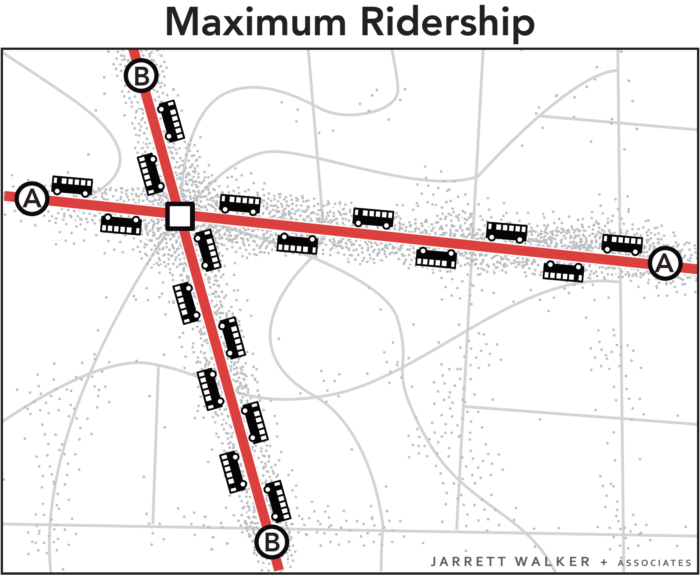
A transit agency pursuing only a ridership goal would focus service on the streets where there are large numbers of people, where walking to transit stops is easy, and where the straight routes feel direct and fast to customers. Because service is concentrated into fewer routes, frequency is high and a bus is always coming soon.

This would result in a network like the one below.

Maximum-Ridership-Illustration-700x575.png

All 18 buses are focused on the busiest areas. Waits for service are short but walks to service are longer for people in less populated areas. Frequency and ridership are high, but some places have no service.
Why is this the way to maximize ridership? Frequency tends to have huge payoffs. Most people find a bus coming every 15 minutes to be more than twice as useful as a bus coming every 30 minutes. Frequency also makes it easier to change between buses, which expands the range of destinations people can reach. So when we concentrate frequency where the most people will benefit from it, we tend to get the best ridership results. If you want to read more about this, see here.

Designing for Coverage​

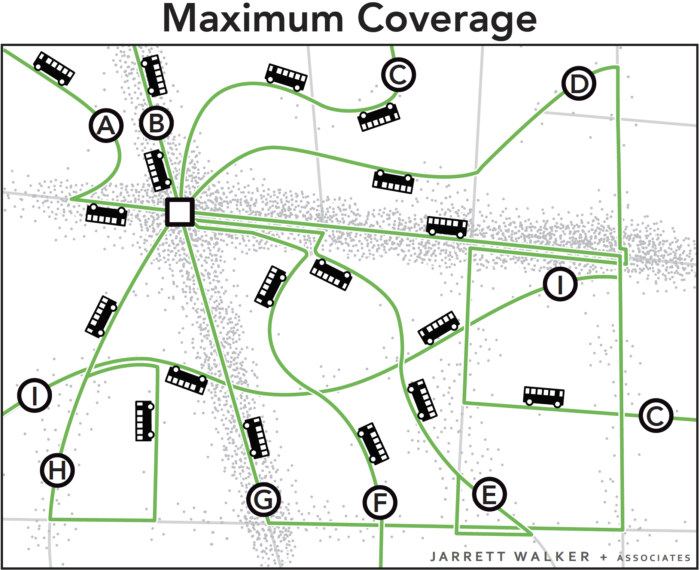
A network designed only for ridership would not go to many parts of the city at all. If you think a transit agency owes some service to everyone in the community, you want a network designed for coverage. To achieve this goal, the transit agency would spread out services so that there would be a bus stop near everyone. Spreading it out sounds great, but it also means spreading it thin. The resources would be divided among so many routes that it wouldn’t be possible to offer much service on any of them. As a result, all routes would be infrequent, even those on the main roads. Infrequent service probably isn’t coming when you need it, so it isn’t very useful, so not many people would ride.

Maximum-Coverage-Illustration-700x570.png

The 18 buses are spread around so that there is a route on every street. Everyone lives near a stop, but every route is infrequent, so waits for service are long. Only a few people can bear to wait so long, so ridership is low.
(By the way, in the coverage network I could have used on-demand or “microtransit” vans instead of buses on fixed lines. This is another tool for providing low-ridership coverage service.)

In these two scenarios, the town is using the same number of buses. These two networks cost the same amount to operate, but they deliver very different outcomes.

Both Goals are Important​

Ridership-oriented networks serve several popular goals for transit, including:

  • Reducing environmental impact through lower Vehicle Miles Travelled.
  • Achieving low public subsidy per rider, through serving the more riders with the same resources, and through fares collected from more passengers.
  • Allowing continued urban development, even at higher densities, without being constrained by traffic congestion.
  • Reducing the cost of for cities to build and maintain road and bridges by replacing automobile trips with transit trips, and by enabling car-free living for some people living near dense, walkable transit corridors
Coverage-oriented networks serve a different set of goals, including:

  • Ensuring that everyone has access to some transit service, no matter where they live.
  • Providing lifeline access to critical services for those who cannot drive.
  • Providing access for people with severe needs.
  • Providing a sense of political equity, by providing service to every municipality or electoral district.
Ridership and coverage goals are both important to many people, but they lead us in opposite directions. Within a fixed budget, if a transit agency wants to do more of one, it must do less of the other.

Because of that, cities and transit agencies that lack adequate resources need to make a clear choice regarding the Ridership-Coverage tradeoff. In fact, we encourage cities to develop consensus on a Service Allocation Policy, which takes the form of a percentage split of resources between the different goals. For example, an agency might decide to allocate 60 percent of its service towards the Ridership Goal and 40 percent towards the Coverage Goal. Our firm has helped many transit agencies think through this question. Here is an explanation of how this conversation played out in a typical US transit agency.

What about your city? How do you think your city should balance the goals of ridership and coverage? There is no technical answer. Your answer will depend on your values.

Further Reading​

Jarrett Walker’s Journal of Transport Geography Paper, which first introduced this concept, is here. (İstenirse atabilirim sonra.)

Kaynak:Basics: The Ridership - Coverage Tradeoff — Human Transit

Kısa olunca ilginin arttığını gözlemlediğim için sonra buna gelen yorumlardan beğendiklerimi farklı bir postta toplayacağım.
 
Geri
Üst