Tema düzenleyici

Toplu Taşıma / Kentsel Planlama / Şehircilik ile Alakalı Makale, Haber vb. Paylaşımı

merhabalar. bunu serbest kürsüye açmak doğru gelmedi onun için @kısayolunuzunu 'n verdiği cesaretle buraya açıyorum. buraya yukarıdaki konular veya ona bağlantılı herhangi bir konuyla alakalı gördüğünüz yazıları paylaşabilirsiniz. Dil sınırlaması yoktur. ilk olarak ben başlatayım:

Dünyadan ziyade Amerika'yla alakalı bir yazı gördüm. Fakat yorumlarda Chris adlı arkadaşın bence sınırları aşan şu yazdıklarına dikkatinizi celbetmek isterim. Özellikle siyahla işaretlediğim yeri önemli buldum:

“Public transit’s costs and benefits are both primarily local (as opposed to something like intercity rail or airports, which exist interaction with faraway places beyond the normal workday commute/labor shed), so services should reflect local needs. Most of the costs of transit are operations: the stuff you cannot avoid and must pay in order to keep what you have (labor, maintenance, fuel, dispatching, service yards, call centers, communications). This is the big hurdle, because transit cannot make money because in order for it to be useful, a lot of unproductive service must be run (peak > weekday midday > weekend daylight > weeknight > weekend night > overnight) as well as coverage services that support ridership services.
Getting a stable subsidy source is important to make a service useful, which means different things to different people. For people who don’t work 9-to-5, it means having bus service available predawn or past sundown. For people living on other people’s schedules (work, school, appointments), it means service frequent enough to show up and go and arrive at both ends in a reasonable amount of time. A frequency of 15 minutes is the point where people will make spontaneous trips and command the schedule to memory, and generally results in the least time wasted in terms of endpoint connections, and still reasonable to make with timed transfers.”

DeepL’den çeviri:
Toplu taşıma maliyetleri ve faydaları öncelikle yerel niteliktedir (normal iş günü işe gidip gelme/iş gücü havzası dışındaki uzak yerlerle etkileşim içinde olan şehirlerarası demiryolları veya havaalanları gibi ulaşım araçlarının aksine), bu nedenle hizmetler yerel ihtiyaçları yansıtmalıdır. Toplu taşıma maliyetlerinin çoğu işletme maliyetleridir: sahip olduklarınızı korumak için kaçınamayacağınız ve ödemek zorunda olduğunuz şeyler (işçilik, bakım, yakıt, sevkiyat, servis sahaları, çağrı merkezleri, iletişim). Bu büyük bir engeldir, çünkü toplu taşıma, yararlı olabilmesi için birçok verimsiz hizmetin (yoğun saatler > hafta içi öğlen > hafta sonu gündüz > hafta içi gece > hafta sonu gece > gece) yanı sıra yolcu hizmetlerini destekleyen kapsama hizmetlerinin de yürütülmesi gerektiğinden para kazanamaz.”

“Hizmetin kullanışlı olması için istikrarlı bir sübvansiyon kaynağına sahip olmak önemlidir, ancak bu farklı kişiler için farklı anlamlar ifade eder. 9-5 mesaisi olmayan kişiler için bu, şafak sökmeden önce veya gün batımından sonra otobüs hizmetinin mevcut olması anlamına gelir. Başkalarının programlarına (iş, okul, randevular) göre yaşayan insanlar için ise, makul bir sürede varış noktasına ulaşmak için yeterince sık hizmet sunulması anlamına gelir. 15 dakikalık sıklık, insanların spontane seyahatler yapıp programı ezberleyecekleri noktadır ve genellikle varış noktası bağlantıları açısından en az zaman kaybına neden olur ve zamanlı aktarmalarla hala makul bir seçenektir.”

kaynak: Many Americans Are Open to Car-Free Living — Human Transit yorumları
 
Son düzenleme:
merhabalar. bunu serbest kürsüye açmak doğru gelmedi onun için @kısayolunuzunu 'n verdiği cesaretle buraya açıyorum. buraya yukarıdaki konular veya ona bağlantılı herhangi bir konuyla alakalı gördüğünüz yazıları paylaşabilirsiniz. Dil sınırlaması yoktur. ilk olarak ben başlatayım:

Dünyadan ziyade Amerika'yla alakalı bir yazı gördüm. Fakat yorumlarda Chris adlı arkadaşın bence sınırları aşan şu yazdıklarına dikkatinizi celbetmek isterim. Özellikle siyahla işaretlediğim yeri önemli buldum:

“Public transit’s costs and benefits are both primarily local (as opposed to something like intercity rail or airports, which exist interaction with faraway places beyond the normal workday commute/labor shed), so services should reflect local needs. Most of the costs of transit are operations: the stuff you cannot avoid and must pay in order to keep what you have (labor, maintenance, fuel, dispatching, service yards, call centers, communications). This is the big hurdle, because transit cannot make money because in order for it to be useful, a lot of unproductive service must be run (peak > weekday midday > weekend daylight > weeknight > weekend night > overnight) as well as coverage services that support ridership services.
Getting a stable subsidy source is important to make a service useful, which means different things to different people. For people who don’t work 9-to-5, it means having bus service available predawn or past sundown. For people living on other people’s schedules (work, school, appointments), it means service frequent enough to show up and go and arrive at both ends in a reasonable amount of time. A frequency of 15 minutes is the point where people will make spontaneous trips and command the schedule to memory, and generally results in the least time wasted in terms of endpoint connections, and still reasonable to make with timed transfers.”

DeepL’den çeviri:
Toplu taşıma maliyetleri ve faydaları öncelikle yerel niteliktedir (normal iş günü işe gidip gelme/iş gücü havzası dışındaki uzak yerlerle etkileşim içinde olan şehirlerarası demiryolları veya havaalanları gibi ulaşım araçlarının aksine), bu nedenle hizmetler yerel ihtiyaçları yansıtmalıdır. Toplu taşıma maliyetlerinin çoğu işletme maliyetleridir: sahip olduklarınızı korumak için kaçınamayacağınız ve ödemek zorunda olduğunuz şeyler (işçilik, bakım, yakıt, sevkiyat, servis sahaları, çağrı merkezleri, iletişim). Bu büyük bir engeldir, çünkü toplu taşıma, yararlı olabilmesi için birçok verimsiz hizmetin (yoğun saatler > hafta içi öğlen > hafta sonu gündüz > hafta içi gece > hafta sonu gece > gece) yanı sıra yolcu hizmetlerini destekleyen kapsama hizmetlerinin de yürütülmesi gerektiğinden para kazanamaz.”

“Hizmetin kullanışlı olması için istikrarlı bir sübvansiyon kaynağına sahip olmak önemlidir, ancak bu farklı kişiler için farklı anlamlar ifade eder. 9-5 mesaisi olmayan kişiler için bu, şafak sökmeden önce veya gün batımından sonra otobüs hizmetinin mevcut olması anlamına gelir. Başkalarının programlarına (iş, okul, randevular) göre yaşayan insanlar için ise, makul bir sürede varış noktasına ulaşmak için yeterince sık hizmet sunulması anlamına gelir. 15 dakikalık sıklık, insanların spontane seyahatler yapıp programı ezberleyecekleri noktadır ve genellikle varış noktası bağlantıları açısından en az zaman kaybına neden olur ve zamanlı aktarmalarla hala makul bir seçenektir.”

kaynak: Many Americans Are Open to Car-Free Living — Human Transit yorumları
Rica ederim hocam, ne yazıkki toplu taşıma yatırımı yapılırken (Özellikle Kuzey Amerika) toplu taşıma getirisi ve ne kadar kar edileceğine bakılıyor.
Zarar eden toplu taşımalar kötüymüş gibi gösteriliyor. Ancak toplu taşıma kültürü ancak çalıştığına güvenebileceğim kadar verimli olursa işe yarar.
Ama bu demek değildir ki her gece metrolar çalışsın, gece saatlerinde raylı sistem kadar ihtiyaç yoksa aynı raylı sistem güzergahında veya benzerinde baykuş hattı açılıp o zaman bile insanlar arabaya mahkum edilmemelidir.
Ki şehirlerimizde yan bölge ulaşımı 21-23 gibi ana merkez ulaşımı ise 12-12.30 gibi bitiyor. Bu özellikle de gece yaşamı kültürü olan (İstanbul,İzmir,Antalya) gibi şehirler için insanları arabaya yönlendirmektir.
Önce düzgün alternatif sunacaksın ki sonra insanları toplu taşımaya zorlayasın.
-Bunlar benim düşüncelerimdir, ama genel şekillenme "Not Just Bikes" YT kanalı çerçevesinde olmuştur.
 
Konu sahibi
Rica ederim hocam, ne yazıkki toplu taşıma yatırımı yapılırken (Özellikle Kuzey Amerika) toplu taşıma getirisi ve ne kadar kar edileceğine bakılıyor.
Zarar eden toplu taşımalar kötüymüş gibi gösteriliyor. Ancak toplu taşıma kültürü ancak çalıştığına güvenebileceğim kadar verimli olursa işe yarar.
Ama bu demek değildir ki her gece metrolar çalışsın, gece saatlerinde raylı sistem kadar ihtiyaç yoksa aynı raylı sistem güzergahında veya benzerinde baykuş hattı açılıp o zaman bile insanlar arabaya mahkum edilmemelidir.
Ki şehirlerimizde yan bölge ulaşımı 21-23 gibi ana merkez ulaşımı ise 12-12.30 gibi bitiyor. Bu özellikle de gece yaşamı kültürü olan (İstanbul,İzmir,Antalya) gibi şehirler için insanları arabaya yönlendirmektir.
Önce düzgün alternatif sunacaksın ki sonra insanları toplu taşımaya zorlayasın.
-Bunlar benim düşüncelerimdir, ama genel şekillenme "Not Just Bikes" YT kanalı çerçevesinde olmuştur.
7/24 raylı sistem çalıştırmak çok zorlayıcı zaten. dünyada bunu başarabilmiş sistemlerin sayısı çok az.
 
Konu sahibi

How Does Municipal Mobility Planning Work?​

by Editorial | UTM
IMG_2963-Herzogenaurach-656x337.jpg

Herzogenaurach | © Urban Transport Magazine/b (evet sanırım bir otokar doruk)
On behalf of the Federal Institute for Research on Building, Urban Affairs and Spatial Development (Bundesinstitut für Bau-, Stadt- und Raumforschung BBSR), PTV Transport Consult analysed the factors that contribute to success within administrative structures, processes, and cultures.

Mobility determines how liveable and attractive a region is. Whether it’s cycle paths, community buses or digital solutions for public transport – in many municipalities, there is great commitment to advancing the mobility transition locally. However, mobility planning is influenced not only by external factors such as population, the economy, or the climate:

“There are also internal barriers within municipal administrations,” (tanıdık bir söz) writes Dr Peter Jakubowski, Head of the Department of Spatial and Urban Development at the BBSR, in the foreword to the PTV Transport Consult study. “Limited financial and human resources, lengthy coordination processes and often inflexible structures slow down necessary change.”

Rural municipalities in particular face major challenges: limited resources, demographic change, and increasing demands from climate protection and digitalisation.

Promising Factors for Successful Mobility Planning

Against this backdrop, the BBSR commissioned PTV Transport Consult to carry out a research project. From April 2024 to October 2025, the project analysed the current state of mobility planning in municipalities across rural regions. The research project Erfolgsversprechende Faktoren innerhalb kommunaler Verwaltungsstrukturen für eine erfolgreiche Mobilitätsplanung (“Promising Factors within Municipal Administrative Structures for Successful Mobility Planning”) was commissioned as part of the Federal Programme Region gestalten (“Shaping the Region”). The programme itself is implemented by the BBSR on behalf of the Federal Ministry for Housing, Urban Development and Building (BMWSB).

Three Levers for Effective Planning

For the project, PTV’s transport experts conducted interviews with employees from 20 municipalities across Germany. These were supplemented by expert analyses and a workshop with specialists from the field. The findings show that successful mobility planning requires a solid foundation in three areas: administrative structures, administrative processes, and administrative culture.

Administrative culture, administrative structurs, administrative processes | © PTV Group

A sound administrative structure is characterised by clear responsibilities, qualified staff, and secure, long-term funding. Within the municipality, mobility planning should be understood as a shared, cross-departmental task.
Efficient administrative processes are marked by integrated strategies, streamlined – ideally digital and agile – workflows.
An integrated mobility strategy with a vision, concrete objectives, suitable measures and continuous performance monitoring forms the basis of effective mobility planning.
Equally important is an administrative culture shaped by openness, innovation and collaboration across departmental boundaries. Leadership that actively embodies and drives cultural change plays a key role in this.


IMG_8954-Pfaffenhofen-1024-copia.jpg
Pfafffenhofen | © Urban Transport Magazine/b

Practical Insights and Concrete Recommendations

The publication prepared by the PTV Transport Consult team provides practical insights and concrete recommendations on how administrative processes – both formal and informal – can be adjusted. The aim is to make mobility planning more targeted and responsive to people’s needs. The publication “Impulses for Successful Mobility Planning in Municipal Administration”(„Impulse für eine erfolgreiche Mobilitätsplanung in der Kommunalverwaltung“, German language) is available for download on the BBSR website (in German language).

Alexander Dahl, Expert Consultant and Project Manager at PTV Transport Consult, highlights the strong motivation evident within municipal administrations:

“I was deeply impressed by the enthusiasm, perseverance and creativity shown by the staff in local administrations as they push mobility planning forward. Their commitment deserves great recognition. This is precisely where our work comes in – showing how structures, processes and an open culture can be shaped to ensure this dedication has the greatest possible impact.”

Efficient Mobility Planning

Using the practical guidance and recommendations provided, municipalities can actively improve their administrative structures, processes, and culture. In addition, they require support from both state and federal levels – for example, through additional personnel, training opportunities, modern technology (digitalisation), and sufficient financial resources. In this way, sustainable mobility planning can ultimately be implemented efficiently and in close alignment with citizens’ needs.

Heidelberg | © Dirk Budach
18.11.2025

kaynak: How Does Municipal Mobility Planning Work? - Urban Transport Magazine
 
Konu sahibi

Chaotic days on the Rodalies suburban train network in Greater Barcelona​

by Editorial | UTM
IMG_7959-Rodalies-Barcelona-1024-656x337.jpg

Rodalies train series 447 at Gelida | © Urban Transport Magazine/b

Several railway accidents have shaken Spain in recent days. In addition to the accident on the Madrid–Seville high-speed line in Andalusia, it was above all the derailment of a suburban commuter train in the autonomous region of Catalonia, triggered by a landslide, that had serious consequences for rail operations. In this accident on Tuesday evening, 20 January 2026, the train driver was killed and at least 37 other people were injured. The incident occurred near Gelida on line R4, one of the suburban rail connections in the Barcelona metropolitan area known in Catalan as “Rodalies”.

In this incident, a train collided with a retaining wall that had collapsed onto the tracks as a result of heavy rainfall. On the same day, just a few hours before the accident in Gelida, another derailment occurred on line R1 between Maçanet-Massanes and Tordera (Barcelona). This was caused by an axle failure following a collision with a boulder that had fallen onto the tracks due to severe weather conditions. No one was injured in this incident.

As a direct consequence of these two accidents, the entire Rodalies rail network was suspended for two consecutive days — Wednesday and Thursday — preventing around 400,000 passengers from travelling. An emergency replacement service using approximately 150 buses proved difficult to organise, as the Rodalies network in the region consists of a total of 16 lines: 13 in the Barcelona metropolitan area and two each in and around the cities of Tarragona and Lleida. Under normal circumstances, more than 460 kilometres of track with 134 stations are served.

Rodalies train series 465 in Barcelona Sants | © Urban Transport Magazine/b
The main reason for the complete suspension of services was the inspection of all operational lines by safety personnel ordered after the accidents, a process that takes time. At the same time, train crews and trade unions drew attention to what they claim has been years of neglect of the rail network and infrastructure, despite repeated warnings by company employees about deficiencies. At the political level, supporters of a full transfer of the system to the regional government once again made their voices heard, assigning responsibility for the condition of the infrastructure and the accidents to the state railway operator RENFE and the state rail infrastructure company ADIF.

In fact, however, similar irregularities have also occurred in recent years on lines operated and maintained by the regionally owned rail authority Ferrocarrils de la Generalitat de Catalunya (FGC). The central government in Madrid had already agreed some time ago to the transfer of operational responsibility for the broad-gauge Rodalies services currently run by RENFE and has prepared the necessary steps.

Normal operations resumed on Friday morning when train services were restored on all lines. The situation deteriorated again, however, when another landslide occurred on line R1 between Blanes and Maçanet-Massanes. Fortunately, the driver of an approaching train managed to stop in time and return with all passengers to the nearest station, meaning that no one was injured. All Rodalies services were again suspended.

For today, 26 January 2026, the resumption of services on large parts of the network has been announced. However, buses continue to operate as rail replacement services on a total of ten sections for the time being. It is likely to take some time before the suburban rail services in the affected area can be described as fully normalised. To calm the heated tempers, all passengers are being offered one month’s free use. of all Rodalies train services.

Regardless of political recriminations and other polemics, the need for renewal is unmistakable in order to improve and stabilise operations — and this is not only the case in the region of Catalonia. The need for investment was recognised and acknowledged some time ago and led, among other things, to the order of 211 new trainsets for various suburban rail networks in Spain, which are operated in regions outside Catalonia under the name ‘Cercanías’.

26.01.2026

Yazıdan çıkardıklarıma dair yazdığım Türkçe özet:
ispanyanın demiryollarında son zamanlarda bir sürü talihsizlik olmaya başlamış. bu sefer 20 Ocak'ta R4 hattında bir tren aşırı yağmur sonucu raylara devrilen bir istinat duvarına çarpmış. sürücü vefat etmiş, 37 yaralı. bundan birkaç saat önce de farklı bir hatta (R1) kötü hava koşulları sonucunda raylara düşmüş bir kayaya başka bir tren çarpıp raylardan çıkmış ve aksı hasar görmüş. bu olaylardan sonra Rodalies demiryolu ağı 2 günlüğüne -çarşamba, perşembe- kapatılmış. yerine olağanüstü hal otobüsleri konulmuş ama bahsi geçen hat 460 kilometre, 16 ayrı hatta sahip, 134 duraklı; buna ayarlanan 150 küsür otobüs tabii ki yetmemiş. suçu hattı işleten özel şirkete yükleyip tekrar devlet eline geçmesini de savunanlar olmuş bu sırada. bu Cuma sabahı geri her şey normale dönmüş. Fakat yine R1 hattında, kayaya çarpan trene yakın bir yerlerde, raylarda heyelan olması sonucunda demiryolu ağı yeniden kapatılmış. buraya yaklaşmakta olan trenin sürücüsü durumu farkedip treni durdurup istasyona geri gitmiş ve olası bir faciayı önlemiş. bugün büyük oranda tekrar açılmış ama on bölgede otobüsler devam ediyormuş. durumu yatıştırmak için bütün yolculara bir aylığına rodalies ağını bedava kullandıracak bilet önerilmiş. inşallah daha sorun yaşanmaz. Yaralılara şifalar diliyorum.

Kaynak:Chaotic days on the Rodalies suburban train network in Greater Barcelona - Urban Transport Magazine
 
Son düzenleme:

Chaotic days on the Rodalies suburban train network in Greater Barcelona​

by Editorial | UTM
IMG_7959-Rodalies-Barcelona-1024-656x337.jpg

Rodalies train series 447 at Gelida | © Urban Transport Magazine/b

Several railway accidents have shaken Spain in recent days. In addition to the accident on the Madrid–Seville high-speed line in Andalusia, it was above all the derailment of a suburban commuter train in the autonomous region of Catalonia, triggered by a landslide, that had serious consequences for rail operations. In this accident on Tuesday evening, 20 January 2026, the train driver was killed and at least 37 other people were injured. The incident occurred near Gelida on line R4, one of the suburban rail connections in the Barcelona metropolitan area known in Catalan as “Rodalies”.

In this incident, a train collided with a retaining wall that had collapsed onto the tracks as a result of heavy rainfall. On the same day, just a few hours before the accident in Gelida, another derailment occurred on line R1 between Maçanet-Massanes and Tordera (Barcelona). This was caused by an axle failure following a collision with a boulder that had fallen onto the tracks due to severe weather conditions. No one was injured in this incident.

As a direct consequence of these two accidents, the entire Rodalies rail network was suspended for two consecutive days — Wednesday and Thursday — preventing around 400,000 passengers from travelling. An emergency replacement service using approximately 150 buses proved difficult to organise, as the Rodalies network in the region consists of a total of 16 lines: 13 in the Barcelona metropolitan area and two each in and around the cities of Tarragona and Lleida. Under normal circumstances, more than 460 kilometres of track with 134 stations are served.

Rodalies train series 465 in Barcelona Sants | © Urban Transport Magazine/b


In fact, however, similar irregularities have also occurred in recent years on lines operated and maintained by the regionally owned rail authority Ferrocarrils de la Generalitat de Catalunya (FGC). The central government in Madrid had already agreed some time ago to the transfer of operational responsibility for the broad-gauge Rodalies services currently run by RENFE and has prepared the necessary steps.

Normal operations resumed on Friday morning when train services were restored on all lines. The situation deteriorated again, however, when another landslide occurred on line R1 between Blanes and Maçanet-Massanes. Fortunately, the driver of an approaching train managed to stop in time and return with all passengers to the nearest station, meaning that no one was injured. All Rodalies services were again suspended.

For today, 26 January 2026, the resumption of services on large parts of the network has been announced. However, buses continue to operate as rail replacement services on a total of ten sections for the time being. It is likely to take some time before the suburban rail services in the affected area can be described as fully normalised. To calm the heated tempers, all passengers are being offered one month’s free use. of all Rodalies train services.

Regardless of political recriminations and other polemics, the need for renewal is unmistakable in order to improve and stabilise operations — and this is not only the case in the region of Catalonia. The need for investment was recognised and acknowledged some time ago and led, among other things, to the order of 211 new trainsets for various suburban rail networks in Spain, which are operated in regions outside Catalonia under the name ‘Cercanías’.

26.01.2026

Yazıdan çıkardıklarıma dair yazdığım Türkçe özet:
ispanyanın demiryollarında son zamanlarda bir sürü talihsizlik olmaya başlamış. bu sefer 20 Ocak'ta R4 hattında bir tren aşırı yağmur sonucu raylara devrilen bir istinat duvarına çarpmış. sürücü vefat etmiş, 37 yaralı. bundan birkaç saat önce de farklı bir hatta (R1) kötü hava koşulları sonucunda raylara düşmüş bir kayaya başka bir tren çarpıp raylardan çıkmış ve aksı hasar görmüş. bu olaylardan sonra Rodalies demiryolu ağı 2 günlüğüne -çarşamba, perşembe- kapatılmış. yerine olağanüstü hal otobüsleri konulmuş ama bahsi geçen hat 460 kilometre, 16 ayrı hatta sahip, 134 duraklı; buna ayarlanan 150 küsür otobüs tabii ki yetmemiş. suçu hattı işleten özel şirkete yükleyip tekrar devlet eline geçmesini de savunanlar olmuş bu sırada. bu Cuma sabahı geri her şey normale dönmüş. Fakat yine R1 hattında, kayaya çarpan trene yakın bir yerlerde, raylarda heyelan olması sonucunda demiryolu ağı yeniden kapatılmış. buraya yaklaşmakta olan trenin sürücüsü durumu farkedip treni durdurup istasyona geri gitmiş ve olası bir faciayı önlemiş. bugün büyük oranda tekrar açılmış ama on bölgede otobüsler devam ediyormuş. durumu yatıştırmak için bütün yolculara bir aylığına rodalies ağını bedava kullandıracak bilet önerilmiş. inşallah daha sorun yaşanmaz. Yaralılara şifalar diliyorum.

Kaynak:Chaotic days on the Rodalies suburban train network in Greater Barcelona - Urban Transport Magazine
Bildiğim kadarıyla İspanya'da, özellikle de eski hatlarda bakım, yenileme ve planlama konusunda büyük problemler var. Hatların çoğunun da özel sektörde olması bu probleme fayda sağlamıyor.
 
Konu sahibi
Bildiğim kadarıyla İspanya'da, özellikle de eski hatlarda bakım, yenileme ve planlama konusunda büyük problemler var. Hatların çoğunun da özel sektörde olması bu probleme fayda sağlamıyor.
Kopyala yapıştır yaparken atladığım bir paragrafta da bunun üzerinden siyaset yapılmasına değinilmiş, sanırım halk da istemiyor özelleşmiş ulaşımı
 
Konu sahibi
Son düzenleme:
Konu sahibi

@kısayolunuzunu ‘nun önerisi üzerine yazıda da bulunanlarla beraber kendim de kalınla çizdiğim şeyler oldu, keyifle okudum siz de keyifle okursunuz inşalllah.​


Why the Northstar was not our North Star: A Tale of a Rail Line Doomed to Fail​

Minnesota’s Northstar is officially dead. While advocates mourn the loss, we have to face the hard truth: we built a park and ride train for a 9-to-5 world that no longer exists.​

Hayden Clarkin's avatar
HAYDEN CLARKIN
JAN 20, 2026

Building good transit is an almost foolproof science. It’s surprisingly hard to execute well, while building bad transit is remarkably easy.


The Northstar Commuter Rail Line, connecting Minneapolis to Big Lake, was a masterclass in the latter. As of last week, its life as a rail service has officially come to an end after the Metropolitan Council defunded the line in favor of express bus service. Now, let me be clear: I do not celebrate the loss of rail service. I believe the Twin Cities, like every major American metro, deserve a regional transit system that could rival Switzerland’s.

But we have to be honest: the Northstar was a useless service. Even if the state leaders who finally axed it did so for political points rather than earnest policy concerns, the result remains the same. Both of these things can be true: the Northstar was a failure of imagination, and its closure is a symptom of our inability to do transit right.

So what was the Northstar?

At its core, the Northstar was a 40-mile commuter rail line connecting Target Field in Minneapolis to Big Lake, MN. At its peak, it ran just a six times a day in each direction.

When the project was originally conceived in the early 2000s, it was far more ambitious. It was designed to reach Rice, MN, just north of St. Cloud, stretching nearly double the length of the line we eventually got. Instead, we ended up with a truncated stump of a route that, frankly, served almost no one.


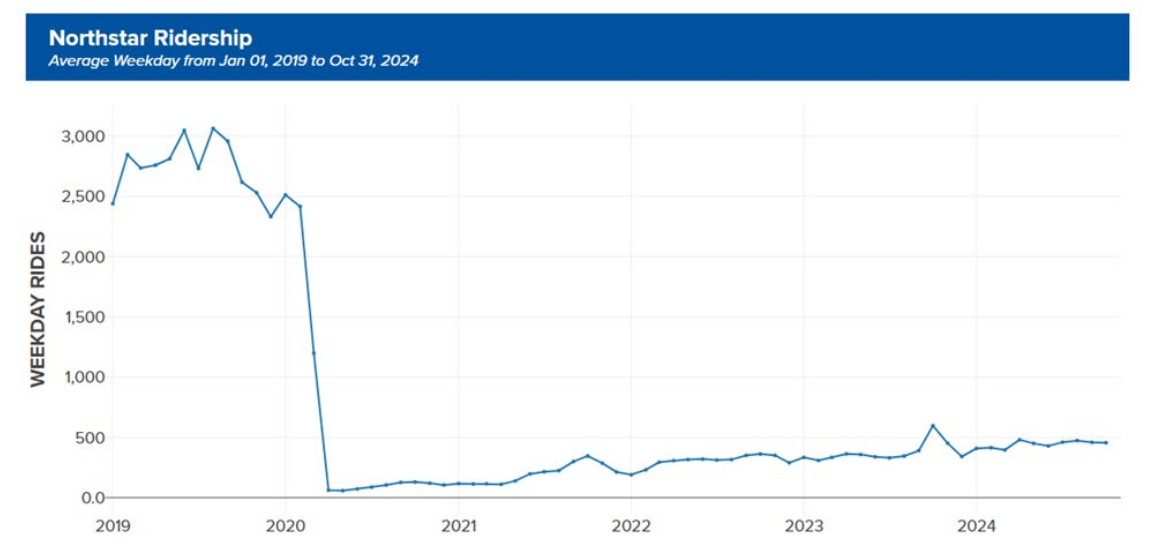
Average Weekday Northstar Ridership from 2019 to 2024 (Met Council)

Post lockdown, the line was the least used rail line in the country, with 430 riders per day, and a subsidy of $116 per rider.

It served almost no one​

The “easy” way to expand transit is to use existing Rights-of-Way (ROW). Because land acquisition is one of the most expensive and politically bruising parts of any project, running trains on existing freight tracks feels like a pragmatic win. But there is a massive catch.


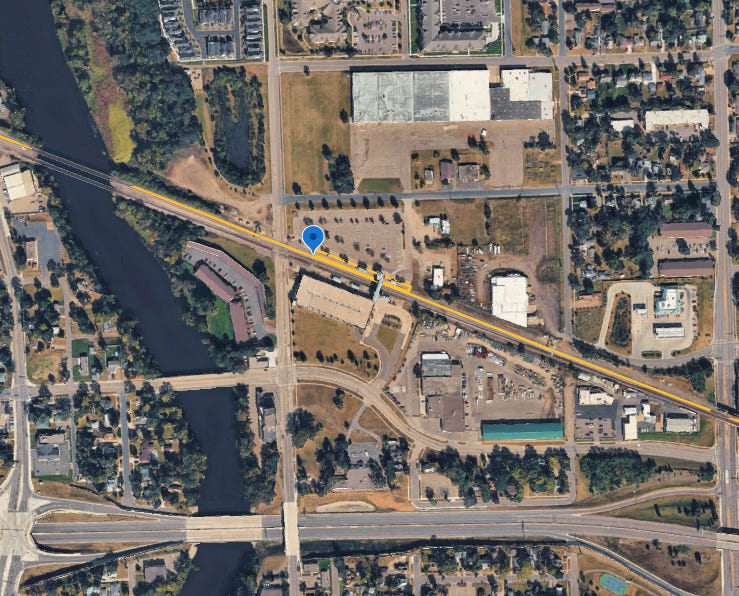
Anoka Station's surrounding land use, or lack thereof

Outside of historic interurban or regional rail corridors, most intercity and freight rail operators built their lines to avoid dense or productive land. Their priority was throughput and flat grades, not neighborhood access. Approaching a city center was a technical necessity for them, not a service goal.

If you run passenger service on those same approaches without aggressively reforming the surrounding land use, you are dead on arrival. The Northstar didn’t just fail to reform land use; its station placement was so poor it bordered on strategic sandbagging.

The Density Exercise

Try this mental exercise: Look at a population density map of the Minneapolis metro area. If you draw lines connecting the densest corridors, you are prioritizing people. If you simply draw a line over an existing rail ROW, you are prioritizing convenience for the state.
Policy makers often treat station placement as a game of “close enough.” They assume that as long as a station is within a municipality’s borders, it is automatically useful and will capture that demand. But that is like moving Grand Central Terminal to Staten Island and expecting it to be as productive as it is on 42nd Street. (Türkiyece karşılığı: Tuzla M4 uzatması istasyonunu İçmeler’den (Kaymakamlığın orası, tersanelere yakın, merkeze yakın dakika başı dolmuş-otobüs geçiyor.) kaldırıp onun yerine gidip de Akfırat’a (Tuzla’nın en kuzey tarafı, nüfusu 2.000~, yakınında bir tek Tepeören, Pendik’in köyleri, Kurtköy var.) koymak ve İçmeler kadar faydalı olacağını düşünmek.)

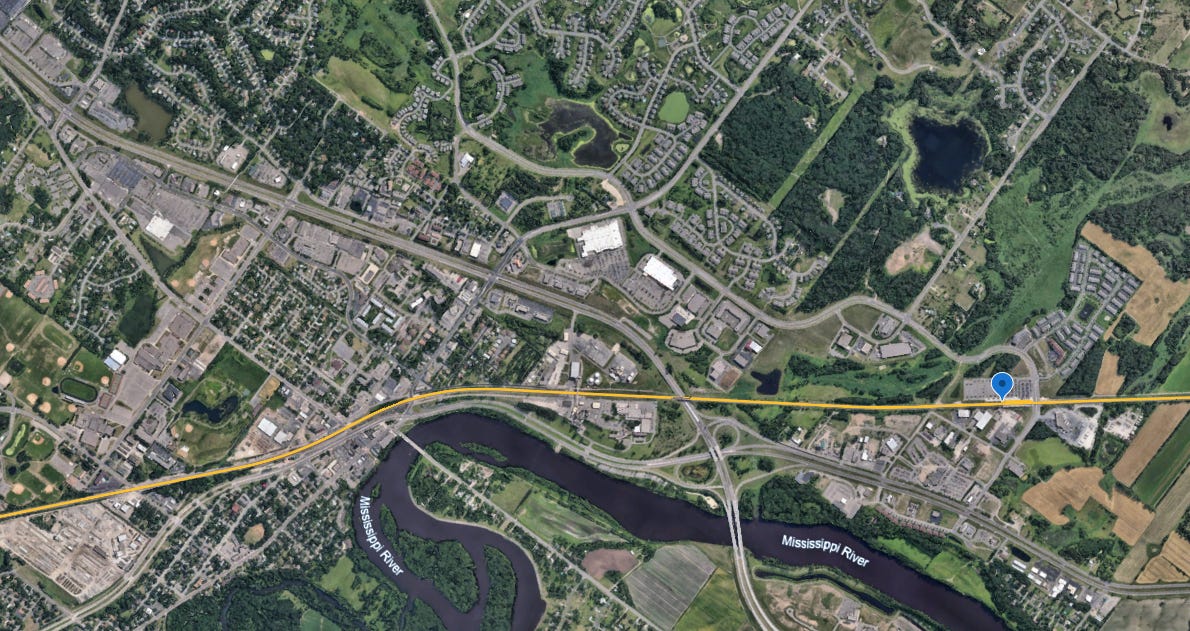
Take the city of Elk River. The Northstar station served the extreme periphery of the town, nowhere near where the actual density of people live. If a commuter is forced to drive to a station just to get on a train, the “transit math” falls apart. Why pay the time penalty of a transfer when you can just stay in your car and drive the entire way? In a city like Minneapolis, the “driving penalty” (traffic and parking costs) isn’t nearly high enough to justify the friction of a poorly located station.


Blue pin showing where Northstar station is in relation to the City of Elk River

It was not built as it was designed

The Northstar was never meant to be a shuttle to a small town. It was initially envisioned as a robust regional rail line connecting the Twin Cities to St. Cloud, a major tertiary city. The hope was that this would be the first spoke in a comprehensive hub-and-spoke system radiating out from Minneapolis.

But then came the budget cuts.

When the money dried up, the project was truncated to end at Big Lake, and just like that, its utility was effectively cut in half. Back in 1999, the late U.S. Rep. Jim Oberstar, a titan of the House Transportation Committee, told the St. Cloud Times exactly what would happen. He warned that the line had to reach St. Cloud, stating bluntly: “It is pointless to have a partial project.”

Fast forward nearly 30 years, and he was proven right. The project was pointless.

Tool vs. Goal Thinking

This failure highlights a chronic issue in American transit planning. When faced with financial constraints, policymakers stop asking "What is the goal?" and start asking "What can we afford to build?"

This is the trap of Tool vs. Goal thinking.

  • The Tool: “We have these rail tracks, what can we put on them?”
  • The Goal: “How do we connect the people of St. Cloud and the Twin Cities with reliable, frequent transit?”
By focusing on the tool (the existing tracks) rather than the goal (connectivity), they built a line that went halfway to nowhere. To make matters worse, the rail line was flanked by bus routes that ran parallel to the tracks, served more actual population centers, and ran much more frequently.


When a bus is more convenient, more frequent, and drops you off closer to your destination than a multi-million dollar train, you haven’t built a transit system, you’ve built a case study to inefficiency.


The Service Was Designed for Failure

Imagine if I gave you access to your car keys for exactly one minute, four times a day. Outside of those tiny windows, your car is essentially a lawn ornament. You would quickly find the utility of that vehicle to be zero compared to the freedom of being able to grab your keys whenever you need them.


This was the fundamental flaw of the Northstar. It wasn’t built for people with lives; it was built for people with 9-to-5 desk jobs in one specific neighborhood.

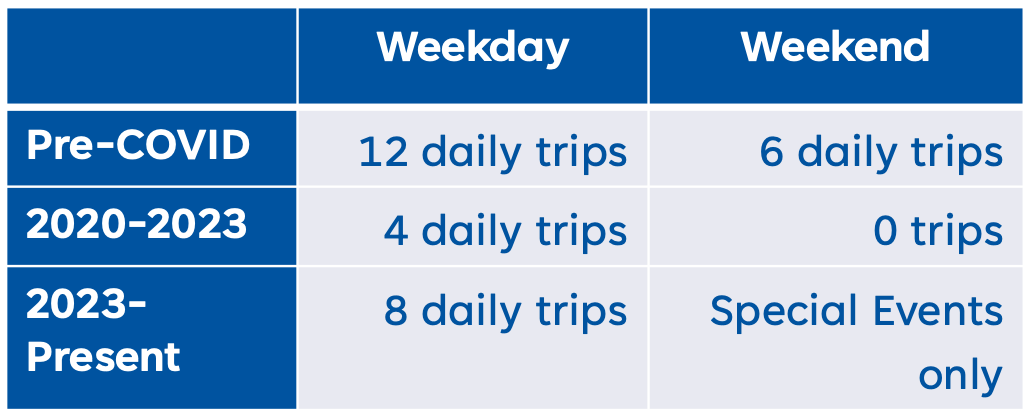
Pre-pandemic, the line saw only 5 or 6 trains daily, strictly serving peak hours, with a measly three trips on the weekend. During the pandemic, that “service” evaporated, dropping to just two trains. Weekend service was slashed entirely, unless there happened to be a Vikings game.

The Reliability Tax

If you choose to take the train, how is a service with such a narrow, inflexible window helpful to you? What happens if you need to stay late at work? What if your kid gets sick at school?

Transit utility is further destroyed when frequency can drop by 200% overnight based on the political whims of the state house. If a system isn’t reliable, people won’t use it. Full stop.

Trains in this context must have clockface schedules. Whether it’s every 15 minutes, 30 minutes, or even once an hour, it needs to be consistent. People need to be able to plan their lives around a service, not pray that the schedule matches their needs. When you make transit a gamble, you’ve already lost the rider. (Alibeyköy bundan ötürü bu kadar nefret kazandı.)

Who was it for?​

When you look at the geography and the schedule, you realize the Northstar wasn’t built for “the public.” It was built for a very specific, very small niche of people. To be a “successful” Northstar rider, you had to fit into a tiny box:

  • You had to work in Downtown Minneapolis (or be one of the people heading to the eight Vikings home games a year).
  • You had to have access to a car to drive to a station, often located on the outskirts of town, but somehow prefer the friction of parking and transferring over just finishing the drive.
  • You had to have a rigid 9-to-5 schedule that perfectly aligned with those few morning and evening train sets.
The numbers tell the story better than any politician could. Per Census data, there were only 4,884 people total who lived in those Northstar towns and worked in Minneapolis.

Think about that. We built an entire heavy rail infrastructure project for a total addressable market of fewer than 5,000 people. Even if you captured 100% of that market, which is impossible for any transit mode, you still wouldn’t have enough ridership to justify the operations. By narrowing the scope to “peak-hour commuters only,” planners effectively guaranteed that the trains would be hauling “moving air” for most of their existence.


The Lessons Learned

The death of the Northstar shouldn’t be used as an argument against rail. Instead, it should be used as a mandatory case study for every DOT and transit agency in the country on how not to spend a dime of public money.

If we want to build a “Swiss-style” system in America, we have to stop making these three fundamental mistakes:

1. A Partial Project is a Pointless Project

We have to stop “let perfect be the enemy of the good,” but we also have to stop letting “cheap be the substitute for functional.” Truncating the Northstar at Big Lake saved money on paper, but it destroyed the utility of the line. If a project requires a certain length to reach its primary market (St. Cloud), and you can’t afford to get there, don’t build it. Redirect that money into high-frequency bus rapid transit (BRT) that actually reaches the people while also densifying. Half-building a train is just a very expensive way to fail. (The DC Streetcar is a perfect example of this!)

2. Land Use is the Only Transit “Hack”

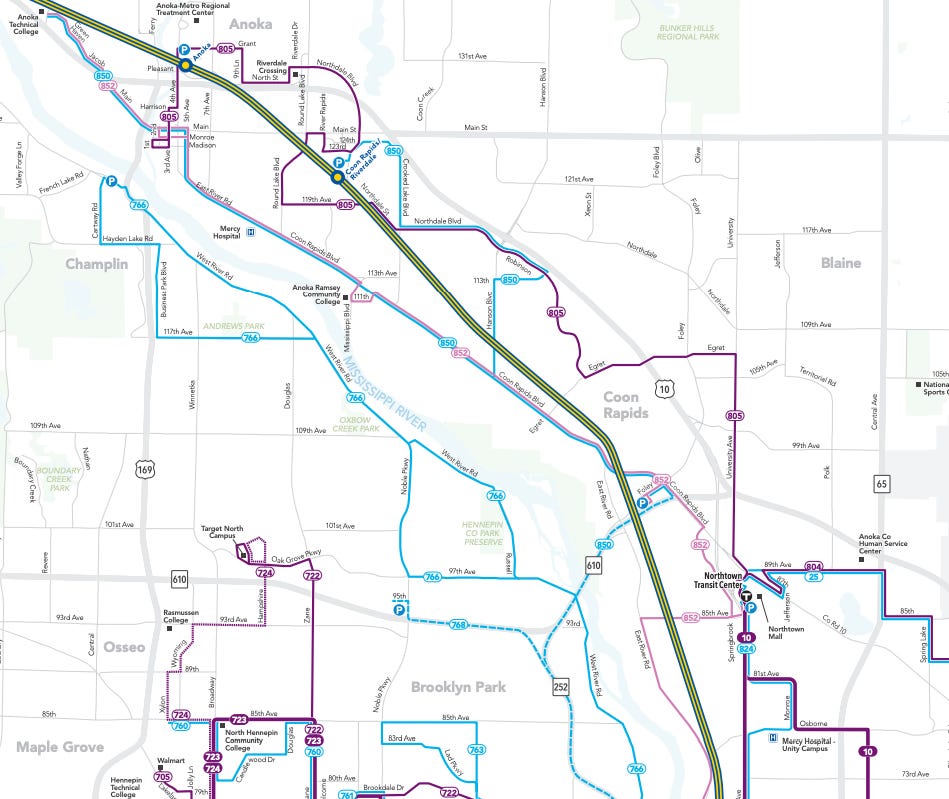
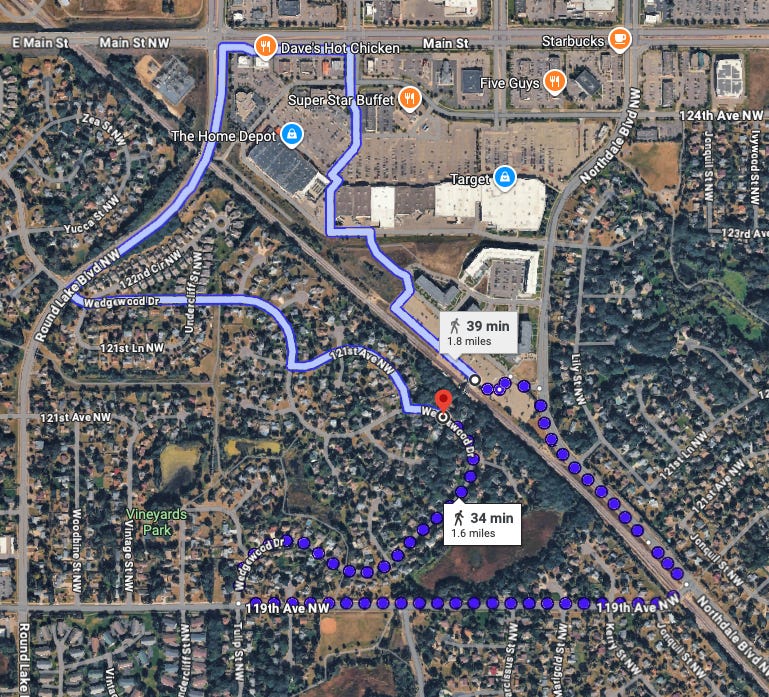
You cannot “engineer” your way out of bad land use. A train station in a field, separated from a town by a four-lane highway, is not a transit asset, it’s a parking lot with tracks. If we aren’t willing to zone for high-density, walkable housing within a quarter-mile of the platform, we shouldn’t be surprised when the trains are empty. You’ll notice that with Coon Rapids’s train station, the abutting home to the platform was a 34-minute walk. Crazy.


The 34-minute walk from the Coon Rapids train station to the nearest home.

3. Frequency is Freedom

The “Commuter Rail” model is dead. The post-pandemic world doesn’t move on a 9-to-5, Monday–Friday rhythm anymore. If a train doesn’t come often enough that a rider can throw away their schedule, it isn’t a viable alternative to a car. We need “regional rail”: all-day, bi-directional, clockface service. If you can’t provide that, you aren’t building a service; you’re building a niche hobby for a handful of suburbanites.

The Northstar wasn’t our North Star. It was a relic of a “tool-first” mentality that prioritized ease of construction over ease of use. If we want people to get out of their cars, we have to stop giving them excuses to stay in them.

For the worst-performing rail line now that Northstar is discontinued, read my piece on Nashville’s WeGo STAR (İlerleyen saatlerde atarım)

Kaynak:Why the Northstar was not our North Star: A Tale of a Rail Line Doomed to Fail
 
Konu sahibi
“Daylighting” (aklıma bir Türkçe çevirisi gelmedi, @kısayolunuzunu benden daha yaratıcı bir insan) kavramının işlendiği bir yazı. 6 kategoriye ayrılmış. Önümüzdeki günlerde teker teker bu kategorilerden seçtiğim bir tanesini atacağım.

Ana yazı:

Nov 20, 2024

Daylighting 101​

A Guide for Communities Seeking Safe Intersections​

Introduction​

Daylighting makes intersections safe by clearing the curb space next to a crosswalk and upgrading that space with infrastructure that benefits the community. Clearing the curb adjacent to intersections ensures that drivers can see people in the crosswalk and that people waiting to cross the street can make eye contact with drivers — all while making space for bioswales, benches, bike parking, bus shelters, or safety improvements.

TA activists and organizers are fighting to increase daylighting across New York City. We secured a pledge from City Hall to daylight 1,000 locations per year and passed a City Council bill guaranteeing at least 100 per year.

But New York is a city of almost 50,000 intersections. As the most pedestrian-dense and traffic-congested city in America, where a pedestrian is killed or has a life-altering serious injury every nine hours, these promises and plans are simply too small.

Now it’s time to advocate for daylighting every intersection in New York City — and ensuring that daylighting is implemented in a way that prevents illegal parking and speeding while upgrading the curb with infrastructure that serves the local community.
A GIF, cycling through different types of daylighting.


Daylighting 101​

Daylighting is a two-step process:​

  1. Clear the curb space next to an intersection to increase visibility
  2. Upgrade that space for the public benefit


Six Types of Daylighting Upgrades​

TA has identified six ways to clear the curb space adjacent to an intersection and upgrade that space with infrastructure your neighborhood needs. For each type of daylighting below, a case study illustrates how different curbside upgrades can respond to different local needs.

Absorbent Daylighting

Clearing the curb space next to a crosswalk and upgrading the space with bioswales, green gutters, and permeable surfaces helps reduce flooding in neighborhoods burdened by excess asphalt and limited natural drainage.

Graphic showing absorbent daylighting.

Bike Daylighting​

Clearing the curb space next to a crosswalk and upgrading the space with on-street bike racks and secure parking stations provides essential bike parking in neighborhoods with limited sidewalk space, high numbers of bike commuters, a network of bike lanes, and many residents living in poverty.

Graphic showing bike daylighting.


Bus Daylighting​

Clearing the curb space next to a crosswalk and upgrading the space with sheltered bus boarding and wait areas supports neighborhoods with many bus commuters, parents with young children, older adults, disabled residents, limited sidewalks, slow buses, and high heat.
Graphic showing bus daylighting.

Cool & Clean Daylighting​

Clearing the curb space next to a crosswalk and upgrading the space with trees and greenery enhances neighborhoods with limited parks, low tree cover, high heat, and elevated levels of asthma, air, and noise pollution.


Graphic depicting cool and clean daylighting.

Safe Daylighting​

Clearing the curb space next to a crosswalk and upgrading the space with curb extensions improves safety in neighborhoods with heavy traffic, high crash rates, parents with young children, older adults, and disabled residents.


Graphic depicting safe daylighting.


Social Daylighting​

Clearing the curb space next to a crosswalk and upgrading the space with café seating, benches, or exercise equipment enhances neighborhoods with limited sidewalks, public seating, parks, and pedestrian plazas, benefiting parents, older adults, disabled residents, and low-income communities.

Graphic depicting social type of daylighting.


Kaynak: Daylighting 101: A Guide for Communities Seeking Safe Intersections — Transportation Alternatives
 
Son düzenleme:
“Daylighting” (aklıma bir Türkçe çevirisi gelmedi, @kısayolunuzunu benden daha yaratıcı bir insan) kavramının işlendiği bir yazı. 6 kategoriye ayrılmış. Önümüzdeki günlerde teker teker bu kategorilerden seçtiğim bir tanesini atacağım.

Ana yazı:

Nov 20, 2024

Daylighting 101​

A Guide for Communities Seeking Safe Intersections​

Introduction​

Daylighting makes intersections safe by clearing the curb space next to a crosswalk and upgrading that space with infrastructure that benefits the community. Clearing the curb adjacent to intersections ensures that drivers can see people in the crosswalk and that people waiting to cross the street can make eye contact with drivers — all while making space for bioswales, benches, bike parking, bus shelters, or safety improvements.

TA activists and organizers are fighting to increase daylighting across New York City. We secured a pledge from City Hall to daylight 1,000 locations per year and passed a City Council bill guaranteeing at least 100 per year.

But New York is a city of almost 50,000 intersections. As the most pedestrian-dense and traffic-congested city in America, where a pedestrian is killed or has a life-altering serious injury every nine hours, these promises and plans are simply too small.

Now it’s time to advocate for daylighting every intersection in New York City — and ensuring that daylighting is implemented in a way that prevents illegal parking and speeding while upgrading the curb with infrastructure that serves the local community.
A GIF, cycling through different types of daylighting.


Daylighting 101​

Daylighting is a two-step process:​

  1. Clear the curb space next to an intersection to increase visibility
  2. Upgrade that space for the public benefit


Six Types of Daylighting Upgrades​

TA has identified six ways to clear the curb space adjacent to an intersection and upgrade that space with infrastructure your neighborhood needs. For each type of daylighting below, a case study illustrates how different curbside upgrades can respond to different local needs.

Absorbent Daylighting

Clearing the curb space next to a crosswalk and upgrading the space with bioswales, green gutters, and permeable surfaces helps reduce flooding in neighborhoods burdened by excess asphalt and limited natural drainage.

Graphic showing absorbent daylighting.

Bike Daylighting​

Clearing the curb space next to a crosswalk and upgrading the space with on-street bike racks and secure parking stations provides essential bike parking in neighborhoods with limited sidewalk space, high numbers of bike commuters, a network of bike lanes, and many residents living in poverty.

Graphic showing bike daylighting.


Bus Daylighting​

Clearing the curb space next to a crosswalk and upgrading the space with sheltered bus boarding and wait areas supports neighborhoods with many bus commuters, parents with young children, older adults, disabled residents, limited sidewalks, slow buses, and high heat.
Graphic showing bus daylighting.

Cool & Clean Daylighting​

Clearing the curb space next to a crosswalk and upgrading the space with trees and greenery enhances neighborhoods with limited parks, low tree cover, high heat, and elevated levels of asthma, air, and noise pollution.


Graphic depicting cool and clean daylighting.

Safe Daylighting​

Clearing the curb space next to a crosswalk and upgrading the space with curb extensions improves safety in neighborhoods with heavy traffic, high crash rates, parents with young children, older adults, and disabled residents.


Graphic depicting safe daylighting.


Social Daylighting​

Clearing the curb space next to a crosswalk and upgrading the space with café seating, benches, or exercise equipment enhances neighborhoods with limited sidewalks, public seating, parks, and pedestrian plazas, benefiting parents, older adults, disabled residents, and low-income communities.

Graphic depicting social type of daylighting.


Kaynak: Daylighting 101: A Guide for Communities Seeking Safe Intersections — Transportation Alternatives
Türkçe terimi Gün Işığı ile Aydınlatma imiş.
 
Türkçe terimi Gün Işığı ile Aydınlatma imiş.

“Daylighting” (aklıma bir Türkçe çevirisi gelmedi, @kısayolunuzunu benden daha yaratıcı bir insan) kavramının işlendiği bir yazı. 6 kategoriye ayrılmış. Önümüzdeki günlerde teker teker bu kategorilerden seçtiğim bir tanesini atacağım.

Ana yazı:

Nov 20, 2024

Daylighting 101​

A Guide for Communities Seeking Safe Intersections​

Introduction​

Daylighting makes intersections safe by clearing the curb space next to a crosswalk and upgrading that space with infrastructure that benefits the community. Clearing the curb adjacent to intersections ensures that drivers can see people in the crosswalk and that people waiting to cross the street can make eye contact with drivers — all while making space for bioswales, benches, bike parking, bus shelters, or safety improvements.

TA activists and organizers are fighting to increase daylighting across New York City. We secured a pledge from City Hall to daylight 1,000 locations per year and passed a City Council bill guaranteeing at least 100 per year.

But New York is a city of almost 50,000 intersections. As the most pedestrian-dense and traffic-congested city in America, where a pedestrian is killed or has a life-altering serious injury every nine hours, these promises and plans are simply too small.

Now it’s time to advocate for daylighting every intersection in New York City — and ensuring that daylighting is implemented in a way that prevents illegal parking and speeding while upgrading the curb with infrastructure that serves the local community.
A GIF, cycling through different types of daylighting.


Daylighting 101​

Daylighting is a two-step process:​

  1. Clear the curb space next to an intersection to increase visibility
  2. Upgrade that space for the public benefit


Six Types of Daylighting Upgrades​

TA has identified six ways to clear the curb space adjacent to an intersection and upgrade that space with infrastructure your neighborhood needs. For each type of daylighting below, a case study illustrates how different curbside upgrades can respond to different local needs.

Absorbent Daylighting

Clearing the curb space next to a crosswalk and upgrading the space with bioswales, green gutters, and permeable surfaces helps reduce flooding in neighborhoods burdened by excess asphalt and limited natural drainage.

Graphic showing absorbent daylighting.

Bike Daylighting​

Clearing the curb space next to a crosswalk and upgrading the space with on-street bike racks and secure parking stations provides essential bike parking in neighborhoods with limited sidewalk space, high numbers of bike commuters, a network of bike lanes, and many residents living in poverty.

Graphic showing bike daylighting.


Bus Daylighting​

Clearing the curb space next to a crosswalk and upgrading the space with sheltered bus boarding and wait areas supports neighborhoods with many bus commuters, parents with young children, older adults, disabled residents, limited sidewalks, slow buses, and high heat.
Graphic showing bus daylighting.

Cool & Clean Daylighting​

Clearing the curb space next to a crosswalk and upgrading the space with trees and greenery enhances neighborhoods with limited parks, low tree cover, high heat, and elevated levels of asthma, air, and noise pollution.


Graphic depicting cool and clean daylighting.

Safe Daylighting​

Clearing the curb space next to a crosswalk and upgrading the space with curb extensions improves safety in neighborhoods with heavy traffic, high crash rates, parents with young children, older adults, and disabled residents.


Graphic depicting safe daylighting.


Social Daylighting​

Clearing the curb space next to a crosswalk and upgrading the space with café seating, benches, or exercise equipment enhances neighborhoods with limited sidewalks, public seating, parks, and pedestrian plazas, benefiting parents, older adults, disabled residents, and low-income communities.

Graphic depicting social type of daylighting.


Kaynak: Daylighting 101: A Guide for Communities Seeking Safe Intersections — Transportation Alternatives

oraya kaldırım koyacağına emniyet + park şeridi yapsın.

hem bu sayede 2 şerit akar. türkiyede şöyle birşey var. emniyet şeridi olmayınca duble yol ise araçlar 2. şeridide parkedip gidebiliyor. sonra trafiğin anası ağlıyor.

1769735184018.png
 
oraya kaldırım koyacağına emniyet + park şeridi yapsın.

hem bu sayede 2 şerit akar. türkiyede şöyle birşey var. emniyet şeridi olmayınca duble yol ise araçlar 2. şeridide parkedip gidebiliyor. sonra trafiğin anası ağlıyor.


Ekli dosyayı görüntüle 105070
Buradaki amaç yaya geçidini, yayaların görünmesini kolaylaştıracak şekilde tasarlamak.
Sizin çizdiğiniz görselde 1+1+P dediğimiz 3 şeritli bir yol var.  Daylighting ile yapmaya çalıştığımız en basit 2 durum var:

  1. Yayaların, araç yolunda geçirdiği süreyi azaltmak.
  2. Yayaları sürücülere daha görünür hale getirmek.
Çizdiğiniz örnekte hatalı parklanma ile yaya geçidi kapatılabilir veya köşeye servis/karavan park etmesi sonucu uzun insanların bile trafiğin aktığı şeride çıkmadan görünmemesi gibi sorunlar oluşmakta.
 
Buradaki amaç yaya geçidini, yayaların görünmesini kolaylaştıracak şekilde tasarlamak.
Sizin çizdiğiniz görselde 1+1+P dediğimiz 3 şeritli bir yol var.  Daylighting ile yapmaya çalıştığımız en basit 2 durum var:

  1. Yayaların, araç yolunda geçirdiği süreyi azaltmak.
  2. Yayaları sürücülere daha görünür hale getirmek.
Çizdiğiniz örnekte hatalı parklanma ile yaya geçidi kapatılabilir veya köşeye servis/karavan park etmesi sonucu uzun insanların bile trafiğin aktığı şeride çıkmadan görünmemesi gibi sorunlar oluşmakta.
Yaya görünsün derken trafik artıyor. yol 3 şeritse 1'e düşüyor.
 
Son düzenleme:
Buradaki amaç yaya geçidini, yayaların görünmesini kolaylaştıracak şekilde tasarlamak.
Sizin çizdiğiniz görselde 1+1+P dediğimiz 3 şeritli bir yol var.  Daylighting ile yapmaya çalıştığımız en basit 2 durum var:

  1. Yayaların, araç yolunda geçirdiği süreyi azaltmak.
  2. Yayaları sürücülere daha görünür hale getirmek.


Çizdiğiniz örnekte hatalı parklanma ile yaya geçidi kapatılabilir veya köşeye servis/karavan park etmesi sonucu uzun insanların bile trafiğin aktığı şeride çıkmadan görünmemesi gibi sorunlar oluşmakta.
1769741639228.png


1769741696152.png


Yol 3 Şerit. + Emniyet Şeridi + Bisiklet yolu gayette Yaya görünüyor.
 
Ekli dosyayı görüntüle 105079

Ekli dosyayı görüntüle 105082

Yol 3 Şerit. + Emniyet Şeridi + Bisiklet yolu gayette Yaya görünüyor.
Gösterdiğiniz yol arteryal yola benziyor. Daylighting'in önerildiği yollar arterler değildir, mahalle içi yerel yollardır.

Arterler ve otobanlarda şerit daraltmanın bu şekilde yapılması zaten mantıklı değil.

Ayrıca fotoğrafını gönderdiğiniz yol sadece 4 değil orta refüjlü 8 şerit (1+3+3+1) yoldur. Böyle bir yolda zaten yayanın olması çok beklenmez.
 
Gösterdiğiniz yol arteryal yola benziyor. Daylighting'in önerildiği yollar arterler değildir, mahalle içi yerel yollardır.

Arterler ve otobanlarda şerit daraltmanın bu şekilde yapılması zaten mantıklı değil.

Ayrıca fotoğrafını gönderdiğiniz yol sadece 4 değil orta refüjlü 8 şerit (1+3+3+1) yoldur. Böyle bir yolda zaten yayanın olması çok beklenmez.
Daylighting'ı burada binaları yıkmadan yapabilirmisiniz?


Lütfen adil olun 😀


1769742640211.png
 
Geri
Üst